
Unit 5
Spotlight
Digital art heist
Ressource affichée de l'autre côté.
Faites défiler pour voir la suite.
Faites défiler pour voir la suite.
angt-unit5-spotlight.mp3

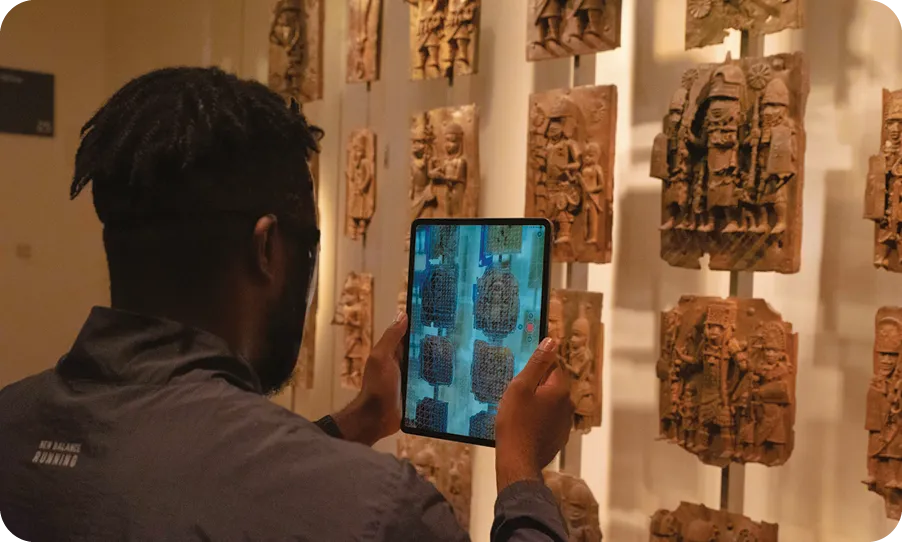
Scanning of the Benin Bronzes by Looty.
Recently, some Western museums, under public pressure, have begun repatriating pieces that had come into their collections via looting. The process can be slow. [...] Last year, in response, Nwaubani and a co-conspirator put on hockey masks, slipped into the basement of the British Museum, and reclaimed a few statues from a group known as the Benin Bronzes. It was the first heist carried out by a collective he'd founded called Looty, whose mission was to “reloot” heritage items. Instead of stealing the pieces, the group scans them in 3-D and makes them available as N.F.T.s in the metaverse. The other day, Nwaubani and his co-founder, Ahmed Abokor, were back at the scene of the not-quite crime. They had come for the Rosetta Stone.
The men wore black sweatsuits and white sneakers. Nwaubani had short braids. Abokor, a Somali Swedish creative director, had a beard. The name of the collective was derived from a Pekingese that French soldiers had snatched from the Old Summer Palace, near Beijing, in 1860, which was eventually given to Queen Victoria. “She called the dog Looty, if you can believe that,” Nwaubani said. The group auctioned the Benin Bronzes as a series of N.F.T.s in May; one went for about two thousand dollars. (Looty gives twenty per cent of its proceeds to young African artists as grants, and keeps the rest to cover costs.)
[...] Their target resembled an ancient chalkboard cramped with writing. They raised their devices. A mesh guide popped up on their screens, over the slab; they hit record, and orbited.
An attendant posted nearby noticed right away. “Hi?” she radioed security. “Yeah, some guys are wearing masks by the Rosetta.”
A buff guard materialized. “So, what's going on here?” he said.
Abokor was cheerful but cryptic. “This is a noncommercial project,” he said. “We are fans of the art work.” There being no clear wrongdoing, the guard moved on.
Deed done, they left the gallery with their eight-hundred-and-ninety-six-megabyte artifact.
The men wore black sweatsuits and white sneakers. Nwaubani had short braids. Abokor, a Somali Swedish creative director, had a beard. The name of the collective was derived from a Pekingese that French soldiers had snatched from the Old Summer Palace, near Beijing, in 1860, which was eventually given to Queen Victoria. “She called the dog Looty, if you can believe that,” Nwaubani said. The group auctioned the Benin Bronzes as a series of N.F.T.s in May; one went for about two thousand dollars. (Looty gives twenty per cent of its proceeds to young African artists as grants, and keeps the rest to cover costs.)
[...] Their target resembled an ancient chalkboard cramped with writing. They raised their devices. A mesh guide popped up on their screens, over the slab; they hit record, and orbited.
An attendant posted nearby noticed right away. “Hi?” she radioed security. “Yeah, some guys are wearing masks by the Rosetta.”
A buff guard materialized. “So, what's going on here?” he said.
Abokor was cheerful but cryptic. “This is a noncommercial project,” he said. “We are fans of the art work.” There being no clear wrongdoing, the guard moved on.
Deed done, they left the gallery with their eight-hundred-and-ninety-six-megabyte artifact.
Ressource affichée de l'autre côté.
Faites défiler pour voir la suite.
Faites défiler pour voir la suite.
PATH A
B1
1-A
Who are the members of the Looty collective,
and what did they do in the British Museum?
2-A
How did Looty manage to reclaim the objects
without stealing them physically?
3-A
Where does the name “Looty” come from?
Ressource affichée de l'autre côté.
Faites défiler pour voir la suite.
Faites défiler pour voir la suite.
PATH B
B2
1-B
Describe the steps Looty took during their
virtual heist. How did they use technology?
2-B
Why does the author describe the event
as a “not-quite crime”?
3-B
Where does the money from the sale
of the N.F.T.s go?
Ressource affichée de l'autre côté.
Faites défiler pour voir la suite.
Faites défiler pour voir la suite.
Let's talk this out!
4
Share your findings. Sum up the purpose of the Looty project.
5
Do you think a digital heist can be a meaningful and effective action? Why or why not?
Ressource affichée de l'autre côté.
Faites défiler pour voir la suite.
Faites défiler pour voir la suite.
Looty on social media
You are a journalist reporting on the Looty project. Create a social media post to present the project. Share your thoughts on how digital approaches can change the way we think about cultural heritage.
You are a journalist reporting on the Looty project. Create a social media post to present the project. Share your thoughts on how digital approaches can change the way we think about cultural heritage.
Une erreur sur la page ? Une idée à proposer ?
Nos manuels sont collaboratifs, n'hésitez pas à nous en faire part.
j'ai une idée !
Oups, une coquille