Vue papier

Découvrez la vue papier en cliquant ici
Unit 11
Activity 2
Your brain on AI
Ressource affichée de l'autre côté.
Faites défiler pour voir la suite.
Faites défiler pour voir la suite.
1
AI: Brain booster or brain drain?
angt-unit11-activity2.mp3

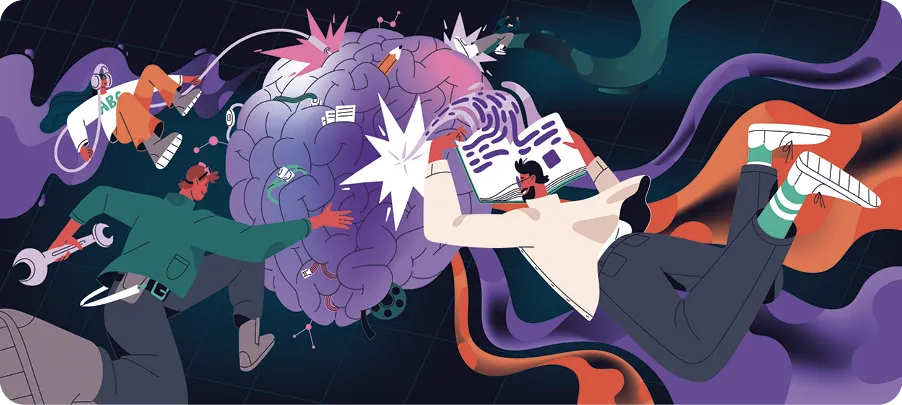
When OpenAI released “study mode” in July 2025, the company touted ChatGPT's educational benefits. “When ChatGPT is prompted to teach or tutor, it can significantly improve academic performance,” the company's vice president of education told reporters at the product's launch.
As a cognitive psychologist who has studied how college students are using AI, I have found that my field offers valuable guidance for identifying when AI can be a brain booster and when it risks becoming a brain drain.
I tell my students the brain is a lot like a muscle: It takes genuine hard work to see gains. Without challenging that muscle, it won't grow bigger.
Now imagine a robot that accompanies you to the gym and lifts the weights for you, no strain needed on your part. Before long, your own muscles will have atrophied and you'll become reliant on the robot at home even for simple tasks like moving a heavy box.
AI, used poorly – to complete a quiz or write an essay, say – lets students bypass the very thing they need to develop knowledge and skills. It takes away the mental workout.
Surface-level use of AI may mean less cognitive burden in the moment, but this is akin to letting a robot do your gym workout for you. It ultimately leads to poorer thinking skills.
Returning to the gym metaphor, it may be useful for students to think of AI as a personal trainer who can keep them on task by tracking and scaffolding learning and pushing them to work harder. AI has great potential as a scalable learning tool, an individualized tutor with a vast knowledge base that never sleeps.
AI technology companies are seeking to design just that: the ultimate tutor. In addition to OpenAI's entry into education, in April 2025 Anthropic released its learning mode for Claude. These models are supposed to engage in Socratic dialogue, to pose questions and provide hints, rather than just giving the answers.
As a cognitive psychologist who has studied how college students are using AI, I have found that my field offers valuable guidance for identifying when AI can be a brain booster and when it risks becoming a brain drain.
I tell my students the brain is a lot like a muscle: It takes genuine hard work to see gains. Without challenging that muscle, it won't grow bigger.
Now imagine a robot that accompanies you to the gym and lifts the weights for you, no strain needed on your part. Before long, your own muscles will have atrophied and you'll become reliant on the robot at home even for simple tasks like moving a heavy box.
AI, used poorly – to complete a quiz or write an essay, say – lets students bypass the very thing they need to develop knowledge and skills. It takes away the mental workout.
Surface-level use of AI may mean less cognitive burden in the moment, but this is akin to letting a robot do your gym workout for you. It ultimately leads to poorer thinking skills.
Returning to the gym metaphor, it may be useful for students to think of AI as a personal trainer who can keep them on task by tracking and scaffolding learning and pushing them to work harder. AI has great potential as a scalable learning tool, an individualized tutor with a vast knowledge base that never sleeps.
AI technology companies are seeking to design just that: the ultimate tutor. In addition to OpenAI's entry into education, in April 2025 Anthropic released its learning mode for Claude. These models are supposed to engage in Socratic dialogue, to pose questions and provide hints, rather than just giving the answers.
Ressource affichée de l'autre côté.
Faites défiler pour voir la suite.
Faites défiler pour voir la suite.
PATH A
B1
1-A
According to the author, why is mental effort
important for learning?
2-A
What can happen if AI does too much of the work
for a student? Give one example from the text.
3-A
Explain how AI can be helpful for learning.
Ressource affichée de l'autre côté.
Faites défiler pour voir la suite.
Faites défiler pour voir la suite.
PATH B
B2
1-B
How does the gym metaphor relate to learning?
2-B
What are the potential cognitive risks of using
AI for tasks like quizzes or essays?
3-B
How could AI be designed to support cognitive
development rather than reduce it?
Ressource affichée de l'autre côté.
Faites défiler pour voir la suite.
Faites défiler pour voir la suite.
Let's talk this out!
4
Share your findings. What are the main benefits and risks of AI for learning?
5
In your opinion, how can you use AI in a way that still gives your brain a “workout”?
Ressource affichée de l'autre côté.
Faites défiler pour voir la suite.
Faites défiler pour voir la suite.
Design a study plan.
You are preparing for an upcoming test and want to use AI wisely. Plan which tasks you will do with AI and which you will tackle on your own, making sure your brain still gets a good “workout.” Write your plan, and be ready to explain how each task makes you learn actively.
You are preparing for an upcoming test and want to use AI wisely. Plan which tasks you will do with AI and which you will tackle on your own, making sure your brain still gets a good “workout.” Write your plan, and be ready to explain how each task makes you learn actively.
Une erreur sur la page ? Une idée à proposer ?
Nos manuels sont collaboratifs, n'hésitez pas à nous en faire part.
j'ai une idée !
Oups, une coquille