Vue papier

Découvrez la vue papier en cliquant ici
Unit A
Activity 2
The story of the Border Reivers
Ressource affichée de l'autre côté.
Faites défiler pour voir la suite.
Faites défiler pour voir la suite.
ang1-unita-activity2.mp3

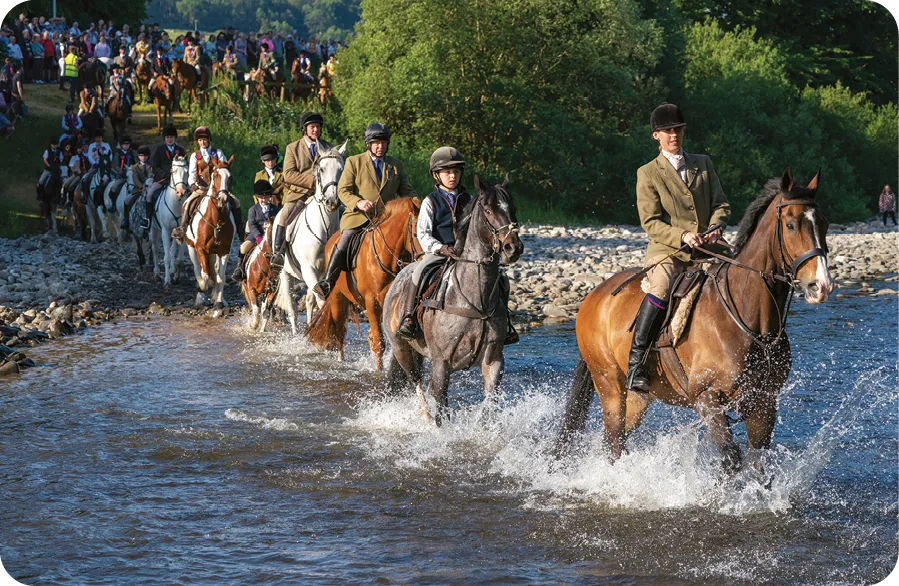
Riders take part in the town's Common Riding, one of the oldest Border festivals in Selkirk, Scotland, June 2023.
During the late Middle Ages, specifically between the late 13th and late 15th centuries, Scotland and England were at war – and the people living in the border areas in both Scotland and England bore the brunt of it.
It was a dangerous time to live in the region, and life was hard. The frequent Anglo-Scottish wars meant that the border areas were often devastated by battles – and even when there wasn't a war ongoing, tensions were always high, leaving the constant threat of further warfare lingering.
What was the point in trying to farm on a piece of land if there was the possibility that it might be destroyed at any time? And besides, arable farming wasn't well-suited to the land in the area, much of which is hilly or open moorland. This type of land is much better for livestock farming, as it's suitable for grazing cattle rather than growing crops – and this made it easy for reivers, as cattle could be easily stolen and smuggled away. [...]
Reiving was a way of life, and a way of making a living. There were reivers on both sides of the border, and raids weren't necessarily only cross-border attacks: Scottish reivers were just as likely to raid other Scottish clans as they were English families. Anyone could be a victim of an attack by the Border Reivers, so long as they weren't direct family. [...]
The legacy of the Border Reivers can still be seen in the annual festivals throughout the Scottish Border towns, with the Riding of the Marches (a ride out on horses around the town boundaries) offering a strong link to these towns' reiving heritage.
There are also a great many depictions of reivers in literature, most notably in Walter Scott's collection of Border Ballads, the Minstrelsy of the Scottish Border. In these, the Border Reiver is depicted as a heroic figure with a strong moral compass and a code of honour, who was a decent person at heart despite any bloodshed.
It was a dangerous time to live in the region, and life was hard. The frequent Anglo-Scottish wars meant that the border areas were often devastated by battles – and even when there wasn't a war ongoing, tensions were always high, leaving the constant threat of further warfare lingering.
What was the point in trying to farm on a piece of land if there was the possibility that it might be destroyed at any time? And besides, arable farming wasn't well-suited to the land in the area, much of which is hilly or open moorland. This type of land is much better for livestock farming, as it's suitable for grazing cattle rather than growing crops – and this made it easy for reivers, as cattle could be easily stolen and smuggled away. [...]
Reiving was a way of life, and a way of making a living. There were reivers on both sides of the border, and raids weren't necessarily only cross-border attacks: Scottish reivers were just as likely to raid other Scottish clans as they were English families. Anyone could be a victim of an attack by the Border Reivers, so long as they weren't direct family. [...]
The legacy of the Border Reivers can still be seen in the annual festivals throughout the Scottish Border towns, with the Riding of the Marches (a ride out on horses around the town boundaries) offering a strong link to these towns' reiving heritage.
There are also a great many depictions of reivers in literature, most notably in Walter Scott's collection of Border Ballads, the Minstrelsy of the Scottish Border. In these, the Border Reiver is depicted as a heroic figure with a strong moral compass and a code of honour, who was a decent person at heart despite any bloodshed.
Ressource affichée de l'autre côté.
Faites défiler pour voir la suite.
Faites défiler pour voir la suite.
PATH A
B1
1-A
Who were the Border Reivers, and why did they
raid farms?
2-A
What kind of land was found in the Scottish
Borders? Why was farming difficult?
3-A
How do Border towns remember the reivers today?
Ressource affichée de l'autre côté.
Faites défiler pour voir la suite.
Faites défiler pour voir la suite.
PATH B
B1+
1-B
What made the Scottish Borders especially
vulnerable in the Middle Ages?
2-B
What was the financial reason for reiving?
3-B
How does the description of reivers in the last
paragraph contrast with the rest of the text?
Ressource affichée de l'autre côté.
Faites défiler pour voir la suite.
Faites défiler pour voir la suite.
Let's talk this out!
4
Share your findings to summarise what aspects of the reivers' legacy are remembered today.
5
Why do you think literature and festivals still celebrate the reivers, despite the violence they caused?
6
In your opinion, are the Border Reivers more like mythical heroes or real historical figures?
Ressource affichée de l'autre côté.
Faites défiler pour voir la suite.
Faites défiler pour voir la suite.
Broadcasting the Border festival
You're a local reporter preparing a short radio ad to invite people to the Riding of the Marches festival. Explain why the festival is exciting, mention its link to the Border Reivers, and encourage listeners to come join the tradition!Une erreur sur la page ? Une idée à proposer ?
Nos manuels sont collaboratifs, n'hésitez pas à nous en faire part.
j'ai une idée !
Oups, une coquille