Vue papier
Découvrez la vue papier en cliquant ici
Unit 2
Activity 2
Border Artivism
Ressource affichée de l'autre côté.
Faites défiler pour voir la suite.
Faites défiler pour voir la suite.
ang1-unit2-activity2.mp3
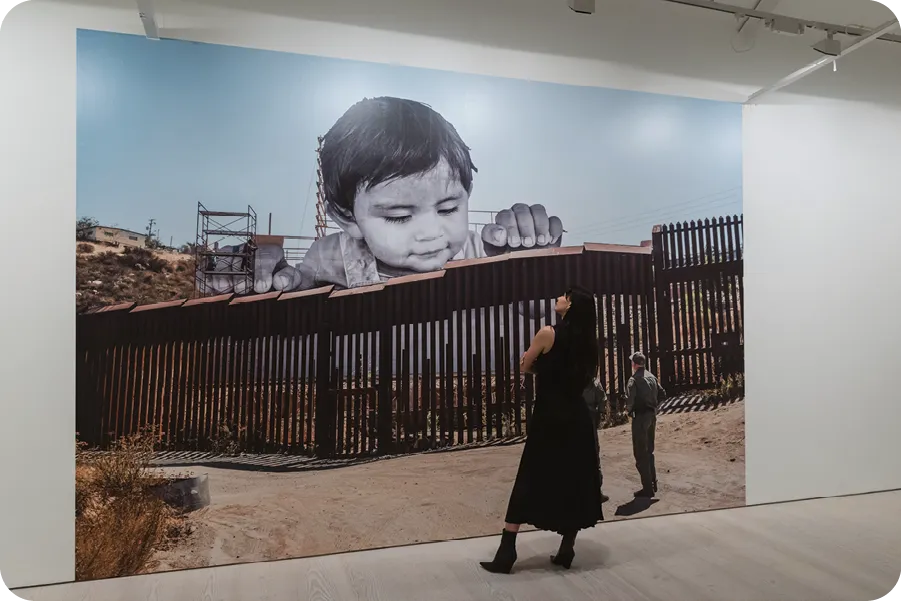
Kikito, JR, 2017.
The examples of border artivism range in scope from graffiti writings, through installations directly on the border fence or in its vicinity, to various performances and actions involving communities from both sides of the border. […] Graffiti written directly on the poles of the fence or corrugated wall constitutes a transgression in itself, as one is not supposed to approach the border, let alone touch it; with current surveillance, such an attempt can have grave consequences. […] The medium of graffiti also allows for the immediacy of reaction; whenever some immigration or border-related issues appear in the media, graffiti provides a prompt response. The installations, in turn, do not share graffiti's characteristic of immediacy, as they require preparation and permits and are often mediated by an artist, like “The Mural of Brotherhood” by Enrique Chiu. Their main role is to transform the border into a space of dialogue that fosters conviviality. In that sense, they also aim to challenge hostipitality experienced by Latinx and other ethnic groups in the U.S. Others point to the complex history of the borderlands, like “The Parade of Humanity”, which emphasized the interconnectedness of the two nation-states. “Border Dynamics” illustrated push and pull factors that determine the dynamics of U.S.-Mexico relations. A French artist JR's “Kikito” (“The Dreamer”) not only alluded to U.S. immigration policies, but also addressed the question of the immigrant as the threatening “Other”, thus provoking a discussion about avarice and fear that led to marginalization of certain groups. Aside from triggering discussions about the “Other”, the majority of those examples of artivism promote the involvement of communities on both sides of the border. In that way, they create a space for dialogue and exchange, opening up the possibility of cooperation between those two seemingly distinct spaces that used to be one.
Ressource affichée de l'autre côté.
Faites défiler pour voir la suite.
Faites défiler pour voir la suite.
PATH A
B1
1-A
Define Border Artivism and give an example.
2-A
Find examples of messages written on the border wall.
3-A
What are the main goals of the artists?
Ressource affichée de l'autre côté.
Faites défiler pour voir la suite.
Faites défiler pour voir la suite.
PATH B
B1+
1-B
Why is graffiti considered a transgression when written on the border wall?
2-B
Pick out three examples and explain how they explore the U.S.-Mexico relationship.
3-B
In what ways are local communities involved in these projects?
Ressource affichée de l'autre côté.
Faites défiler pour voir la suite.
Faites défiler pour voir la suite.
Let's talk this out!
4
Share your answers, and find what can make art projects more impactful.
5
To what extent can Border Artivism help change people's perception?
6
Do you believe that art can challenge stereotypes and promote social change?
Ressource affichée de l'autre côté.
Faites défiler pour voir la suite.
Faites défiler pour voir la suite.
Act out a conversation at the border.
Imagine you are standing at the U.S.-Mexico border, looking at a piece of Border Art. In pairs, choose who you want to be (a local resident, student, border patrol officer, migrant, artist, etc.) and share your impressions. Talk about what you see, how it makes you feel, and what message you think it conveys.
Imagine you are standing at the U.S.-Mexico border, looking at a piece of Border Art. In pairs, choose who you want to be (a local resident, student, border patrol officer, migrant, artist, etc.) and share your impressions. Talk about what you see, how it makes you feel, and what message you think it conveys.
Une erreur sur la page ? Une idée à proposer ?
Nos manuels sont collaboratifs, n'hésitez pas à nous en faire part.
j'ai une idée !
Oups, une coquille