Unit 6
Activity 3
This is America: framing the crisis today
Ressource affichée de l'autre côté.
Faites défiler pour voir la suite.
Faites défiler pour voir la suite.
Group 1Matt Black: The Geography of Poverty
Group 1
Ressource affichée de l'autre côté.
Faites défiler pour voir la suite.
Faites défiler pour voir la suite.
Magnum Photos
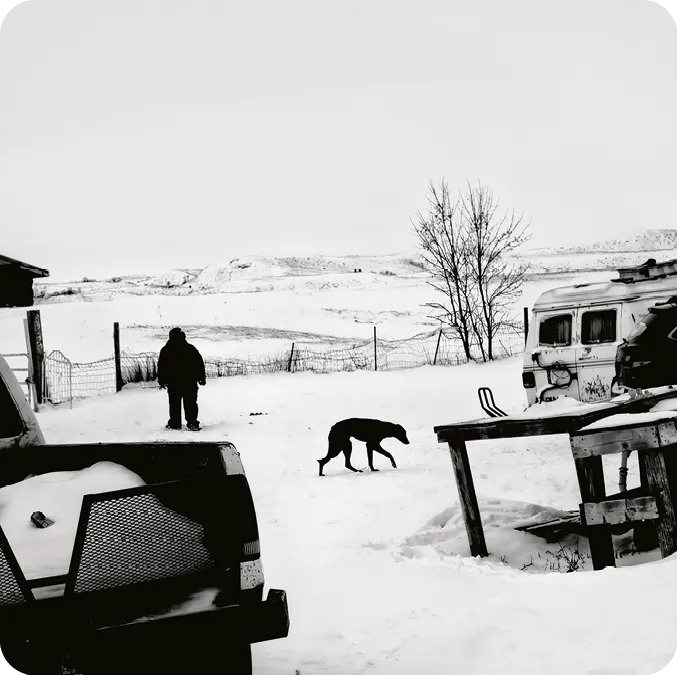
Matt Black, At a Ranch House, Eagle Butte, South Dakota, 2016.
For the past four years, Matt Black has wondered about an alternate title for his documentary project The Geography of Poverty. Since 2014, the work has taken him on four cross-country trips over 80,000 miles, photographing communities in 46 states. “It could have just as easily been called The Geography of Power,” Black says, soon after returning from his fourth trip, which lasted nine months. “It's something much more complicated than economics; it's about social power. Who gets their needs met and who doesn't?”
According to the U.S. Census Bureau, 12.7 % of Americans – or 40 million people – live in poverty. To Black, poverty is not really a question of economics but rather a lived experience of power. But how do you make visible something ingrained in the very fabric of our society?
The Geography of Poverty grew out of Black's work in the Central Valley of California, where he lives. He soon wanted to show that California is not an outlier – making a broader statement about poverty as a national phenomenon. He focused on census-designated places where 20 % or more of the population was living in poverty – and was able to cross the country several times in all directions without ever leaving these communities. That in itself was striking.
“From a ground level, America looks very different from the stories we like to tell ourselves,” he says. America has always presented itself as the land of opportunity. Black wanted to re-evaluate that powerful myth and explore whether the American dream is even still viable.
That myth is not just potent; it's also isolating. “The stigma of poverty is one of the devices by which people's voices are suppressed and the reality is obscured,” Black says. He is particularly interested in how poverty diminishes one's self-esteem, thereby maintaining this dynamic between the powerful and powerless.
His stark black-and-white photographs can seem almost like fine art, but Black says he doesn't think of them in terms of beauty at all. “Does a photograph contain a certain truth, a certain depiction of life?” he says. “Photography is a language I'm using to address abstract concepts like powerlessness. It's a lot more complicated than just aesthetics.”
According to the U.S. Census Bureau, 12.7 % of Americans – or 40 million people – live in poverty. To Black, poverty is not really a question of economics but rather a lived experience of power. But how do you make visible something ingrained in the very fabric of our society?
The Geography of Poverty grew out of Black's work in the Central Valley of California, where he lives. He soon wanted to show that California is not an outlier – making a broader statement about poverty as a national phenomenon. He focused on census-designated places where 20 % or more of the population was living in poverty – and was able to cross the country several times in all directions without ever leaving these communities. That in itself was striking.
“From a ground level, America looks very different from the stories we like to tell ourselves,” he says. America has always presented itself as the land of opportunity. Black wanted to re-evaluate that powerful myth and explore whether the American dream is even still viable.
That myth is not just potent; it's also isolating. “The stigma of poverty is one of the devices by which people's voices are suppressed and the reality is obscured,” Black says. He is particularly interested in how poverty diminishes one's self-esteem, thereby maintaining this dynamic between the powerful and powerless.
His stark black-and-white photographs can seem almost like fine art, but Black says he doesn't think of them in terms of beauty at all. “Does a photograph contain a certain truth, a certain depiction of life?” he says. “Photography is a language I'm using to address abstract concepts like powerlessness. It's a lot more complicated than just aesthetics.”
Ressource affichée de l'autre côté.
Faites défiler pour voir la suite.
Faites défiler pour voir la suite.
Questions
You are in charge of one document.
1
What is the main message or goal the artist wants to share through their work?
2
What role does personal or community identity play in the photographer's project?
3
How do the visual elements (such as composition, lighting and subjects) support or enhance the message of the work?
Let's talk this out!
4
Share the main messages from each group's document. What are the similarities and differences?
5
How do the photographers use images to challenge or change common ideas about poverty?
6
Do you think it is important to have voices from within communities creating these images, rather than outside observers?
Ressource affichée de l'autre côté.
Faites défiler pour voir la suite.
Faites défiler pour voir la suite.
➜ La traduction de « cadre »
Frame : la bordure qui entoure une image. Ce mot peut aussi être un verbe, to frame.
Setting : là où se déroule une scène.
Environment : le milieu dans lequel quelque chose existe.
Context : les informations qui situent un événement.
Executive or Manager : un responsable dans une entreprise.
Frame : la bordure qui entoure une image. Ce mot peut aussi être un verbe, to frame.
Setting : là où se déroule une scène.
Environment : le milieu dans lequel quelque chose existe.
Context : les informations qui situent un événement.
Executive or Manager : un responsable dans une entreprise.
Ressource affichée de l'autre côté.
Faites défiler pour voir la suite.
Faites défiler pour voir la suite.
Retrouvez des fiches activité pour chaque groupe.
Ressource affichée de l'autre côté.
Faites défiler pour voir la suite.
Faites défiler pour voir la suite.
Find one keyword for each photographer's work and write them on separate slips of paper. Exchange them with a partner and see if they can match each keyword to the correct photographer.
Ressource affichée de l'autre côté.
Faites défiler pour voir la suite.
Faites défiler pour voir la suite.
Record a radio pitch.
You've been invited to record a one-minute audio pitch for a youth feature on the radio show “The People Behind the Picture”, in partnership with MoMA. Choose a real or imagined photo that tells an important story from your community or experience. Describe what the photo shows, explain the story behind it, and give reasons why it should be shared with the public.Une erreur sur la page ? Une idée à proposer ?
Nos manuels sont collaboratifs, n'hésitez pas à nous en faire part.
j'ai une idée !
Oups, une coquille