Vue papier
Découvrez la vue papier en cliquant ici
Unit 7
Final Project
Ressource affichée de l'autre côté.
Faites défiler pour voir la suite.
Faites défiler pour voir la suite.
On Poetry Day, your school organizes a contest called “Rhyme for your rights”. Just as rappers like Tupac, Public Enemy and Kendrick Lamar have used their lyrics to address issues like racial inequality, police brutality, and poverty, the contest hopes to give young voices a similar platform.
Ressource affichée de l'autre côté.
Faites défiler pour voir la suite.
Faites défiler pour voir la suite.
Write your poem.
Choose a social issue and write a poem about it. Whether it's about equality, freedom, mental health, or any topic that matters to you — your words can make an impact!

Eminem performing in a rap battle scene.
Ressource affichée de l'autre côté.
Faites défiler pour voir la suite.
Faites défiler pour voir la suite.
Let's do it!
- Think big: jot down all the struggles you can think of and their context.
- Pick your passion: choose the one that speaks to you the most.
- Map it out: create a mind map of words linked to your issue and find rhymes that fit.
- Build the beat: use the words from your map to craft short, punchy sentences.
- Express yourself: think about how you want to share your feelings on this topic.
- Feel the vibes: list words that reflect your emotions and stance on the issue.
- Write with rhythm: let the rhythm guide you as you shape your text.
Ressource affichée de l'autre côté.
Faites défiler pour voir la suite.
Faites défiler pour voir la suite.
Niveau A2 | Niveau A2+ | Niveau B1 | Niveau B1+ | Vers B2 | |
|---|---|---|---|---|---|
| Réalisation de la tâche | |||||
| Cohérence et organisation | |||||
| Recevabilité linguistique | |||||
| Contenus culturels |
Ressource affichée de l'autre côté.
Faites défiler pour voir la suite.
Faites défiler pour voir la suite.
➤ Préparez et organisez vos idées
- Choisissez une thématique : trouvez un sujet qui vous touche (ex. : égalité, liberté, santé mentale, etc.).
- Posez-vous des questions : What do I want my readers to feel? What message do I want to send?
- Faites une carte mentale : notez des mots-clés, images, expressions et références culturelles liées à votre sujet.
➤ Construisez le texte et travaillez la forme
- Structurez vos idées : début (introduction), milieu (développement), fin (conclusion ou appel à l'action).
- Travaillez le rythme et la musicalité : utilisez des répétitions, anaphores, rimes, allitérations, assonances…
- Utilisez des figures de style pour renforcer le message : métaphores, comparaisons.
- Jouez avec l'ordre des mots pour créer des effets de surprise ou d'intensité.
- Alternez phrases courtes et longues pour créer un effet dynamique.
➤ Améliorez la fluidité et l'impact du poème
- Relisez à voix haute pour entendre le rythme et repérer les phrases qui manquent de flow.
- Ajustez les rimes et jeux de mots pour donner plus de musicalité et d'impact.
- Vérifiez la cohérence et la clarté du message : chaque ligne doit servir votre idée principale.
- Cherchez des synonymes pour enrichir le vocabulaire, et testez leur musicalité.
Ressource affichée de l'autre côté.
Faites défiler pour voir la suite.
Faites défiler pour voir la suite.

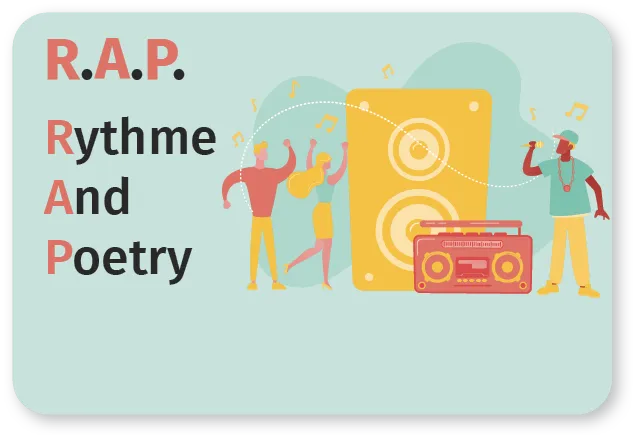
“How to write a rap, poem or song”,
Team Filmanthropy, 2020.
Vidéo associée
Ressource affichée de l'autre côté.
Faites défiler pour voir la suite.
Faites défiler pour voir la suite.
Create a promotional poster
Promote the “Rhyme for Your Rights” contest by designing a poster that will encourage students to join this powerful event. Your poster should highlight the theme of using rap and poetry to raise awareness about important social issues. Think about what message will inspire others to participate, how to represent the energy and passion of the contest, and how to make sure everyone knows when and where it's happening.

Ressource affichée de l'autre côté.
Faites défiler pour voir la suite.
Faites défiler pour voir la suite.
Let's do it!
- Gather your notes: revisit protest poems, rap lyrics, messages and visual styles from the chapter. Let them inspire your tone, message, and look.
- Choose the key information to include: name of the event, who can take part, what to submit, when and where it happens, and what's at stake. Include some elements to define the genre and its influence
- Find a slogan or tagline that reflects the contest's purpose: speaking up through poetry or rap about a cause that matters.
- Select a strong visual identity: think of color choices, images (like mics, fists, books, chains breaking), and design inspired by protest culture or hip-hop style.
- Keep your audience in mind: speak directly to the students. Make your poster engaging!
- Plan your layout: make the poster easy to read
from a distance, with bold fonts and a good
balance of text and images.
Dépliez pour dessiner le schéma
Une erreur sur la page ? Une idée à proposer ?
Nos manuels sont collaboratifs, n'hésitez pas à nous en faire part.
j'ai une idée !
Oups, une coquille