Vue papier
Découvrez la vue papier en cliquant ici
Case Study 8
Axe 3
Objet d'étude 1
The visual legacy of Japanese-American internment
Ressource affichée de l'autre côté.
Faites défiler pour voir la suite.
Faites défiler pour voir la suite.
Create a multimedia slideshow.
You are a team of museum curators creating a multimedia exhibit on Manzanar and the internment of Japanese-Americans during WWII. Design a slideshow that contrasts censored and uncensored views, shows how perceptions have evolved, and encourages visitors to reflect and engage in meaningful dialogue.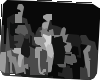

Dorothea Lange, Members of the Japanese-American Mochida family awaiting re-location to a camp, Hayward, California, 1942.
Ressource affichée de l'autre côté.
Faites défiler pour voir la suite.
Faites défiler pour voir la suite.
1Images under lock

Vidéo associée
Ressource affichée de l'autre côté.
Faites défiler pour voir la suite.
Faites défiler pour voir la suite.
Once upon street art…
At first glance, Dorothea Lange's photographs of Japanese-Americans, taken in the early 1940s, appear to show ordinary activities. People wait patiently in lines. Children play. A woman makes artificial flowers. Storefront signs proudly proclaim, "I am an American."
But these quiet images document something sinister: the racially motivated relocation and internment during World War II of more than 110,000 people of Japanese ancestry who lived on the West Coast, more than 60 percent of whom were American citizens. […]
Although Ms. Lange's photographs were commissioned by the federal government as part of its documentary programs, they were suppressed for the duration of the war. Never actively distributed, her prints were sometimes defaced by military personnel, the word "impounded" scrawled across them. After the war ended, the photographs were discreetly deposited in the National Archives, where they remained, largely unseen and unpublished, for decades. […]
At the time, the internment was hailed by some and condemned by others. Activists warned that the incarceration of loyal and patriotic Americans would do little to protect the nation, and would serve instead as grist for enemy propaganda. In retrospect, some have compared the internment centers to concentration camps. Nevertheless, in February 1942, two months after Japan attacked Pearl Harbor, President Franklin D. Roosevelt issued an executive order that authorized the exclusion of all people of Japanese descent, both citizens and immigrants, from the West Coast. The order, which presumed that Japanese-Americans were disloyal and potentially traitorous, was meant to protect the country's most vulnerable assets, including airports, power plants, railroads, shipyards and military installations, from sabotage and spying.
But these quiet images document something sinister: the racially motivated relocation and internment during World War II of more than 110,000 people of Japanese ancestry who lived on the West Coast, more than 60 percent of whom were American citizens. […]
Although Ms. Lange's photographs were commissioned by the federal government as part of its documentary programs, they were suppressed for the duration of the war. Never actively distributed, her prints were sometimes defaced by military personnel, the word "impounded" scrawled across them. After the war ended, the photographs were discreetly deposited in the National Archives, where they remained, largely unseen and unpublished, for decades. […]
At the time, the internment was hailed by some and condemned by others. Activists warned that the incarceration of loyal and patriotic Americans would do little to protect the nation, and would serve instead as grist for enemy propaganda. In retrospect, some have compared the internment centers to concentration camps. Nevertheless, in February 1942, two months after Japan attacked Pearl Harbor, President Franklin D. Roosevelt issued an executive order that authorized the exclusion of all people of Japanese descent, both citizens and immigrants, from the West Coast. The order, which presumed that Japanese-Americans were disloyal and potentially traitorous, was meant to protect the country's most vulnerable assets, including airports, power plants, railroads, shipyards and military installations, from sabotage and spying.
Ressource affichée de l'autre côté.
Faites défiler pour voir la suite.
Faites défiler pour voir la suite.
Step 1
Read the text.
1
Who was sent to internment camps during World War II, and why?
2
How did Americans react to the internment at the time?
3
What role did Dorothea Lange play?
Watch the video.
4
Why were some of Dorothea Lange's photographs censored by the government? Give examples.
Action!
Write a curator's note explaining why the government censored certain images, and how Dorothea Lange's photographs reveal hidden truths.
Ressource affichée de l'autre côté.
Faites défiler pour voir la suite.
Faites défiler pour voir la suite.





Ressource affichée de l'autre côté.
Faites défiler pour voir la suite.
Faites défiler pour voir la suite.
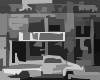
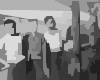
Manzanar, located in California, was one of ten internment camps where the U.S. government forcibly confined over 110,000 Japanese‑Americans during World War II, following the attack on Pearl Harbor in 1941. Today, Manzanar is preserved as a National Historic Site to remember this dark chapter in American history and honor those who lived through it.
Ressource affichée de l'autre côté.
Faites défiler pour voir la suite.
Faites défiler pour voir la suite.
Step 2
Look at the three photographs.
1
What differences do you notice in the way each photographer shows the Manzanar camp?
Listen to the audio.
2
Note down information about each of the three photographers. What makes each of their perspectives unique?
3
How has the way people view and understand Manzanar changed over time?
Action!
Record a short audio guide for visitors that explains the different perspectives of the three photographers and why it is important to present these varied views.
Cliquez pour accéder à un module d'enregistrement audio
Enregistreur audio
Ressource affichée de l'autre côté.
Faites défiler pour voir la suite.
Faites défiler pour voir la suite.
Ready...
- Gather your notes about Manzanar and the internment of Japanese‑Americans. Focus on the perspectives, the emotions they convey, and how they have shaped public perception over time.
Steady...
- Go online and select the most powerful images.
- Plan your slideshow's outline and prepare captions for each slide.
Go!
- Record the voice-over for your slideshow, timed with your chosen images. Make it engaging and informative to help visitors understand the complex history of Manzanar.
Une erreur sur la page ? Une idée à proposer ?
Nos manuels sont collaboratifs, n'hésitez pas à nous en faire part.
j'ai une idée !
Oups, une coquille