Vue papier
Découvrez la vue papier en cliquant ici
Unit B
Activity 2
But still a long way to go!
Ressource affichée de l'autre côté.
Faites défiler pour voir la suite.
Faites défiler pour voir la suite.
ang1-unitb-activity2.mp3
She's in competition with history, which has always been dismissive of her power. Until very recently, museums wouldn't buy her work, art
historians wouldn't acknowledge her and commercial galleries would
only rarely represent her. She's a miracle, a marvel, a mystic, a seductress,
a changeling, a visionary, a man-hater, a freak; she's never considered
normal. She knows that no two women are the same. She knows that she
has always been here, there and everywhere, but for reasons that baffle
her, people still refuse to see her. Even now, decades or centuries after she
has died, her magnificent achievements remain largely unsung; there are
still countless museums, galleries and collectors who do not appreciate her
worth, who do not rate her, who are not interested in the many stories she
has to tell. She still has so far to travel. [...]
The museums of the world are filled with paintings of women – by men. Ask around and you'll find that most people struggle to name even one female artist from before the twentieth century. Yet women have always made art, even though, over the centuries, every discouragement was – and, in many ways, still is – placed in their way. [...]
For the first time, artists who were previously ignored, patronised, marginalised or ostracised due to their gender, race, sexuality or class, are being recognised for their originality and resilience. The infinitely varied work of these artists embodies the fact that there is more than one way to understand our planet, more than one way to live in it and more than one way to make art about it.
The museums of the world are filled with paintings of women – by men. Ask around and you'll find that most people struggle to name even one female artist from before the twentieth century. Yet women have always made art, even though, over the centuries, every discouragement was – and, in many ways, still is – placed in their way. [...]
For the first time, artists who were previously ignored, patronised, marginalised or ostracised due to their gender, race, sexuality or class, are being recognised for their originality and resilience. The infinitely varied work of these artists embodies the fact that there is more than one way to understand our planet, more than one way to live in it and more than one way to make art about it.
Ressource affichée de l'autre côté.
Faites défiler pour voir la suite.
Faites défiler pour voir la suite.
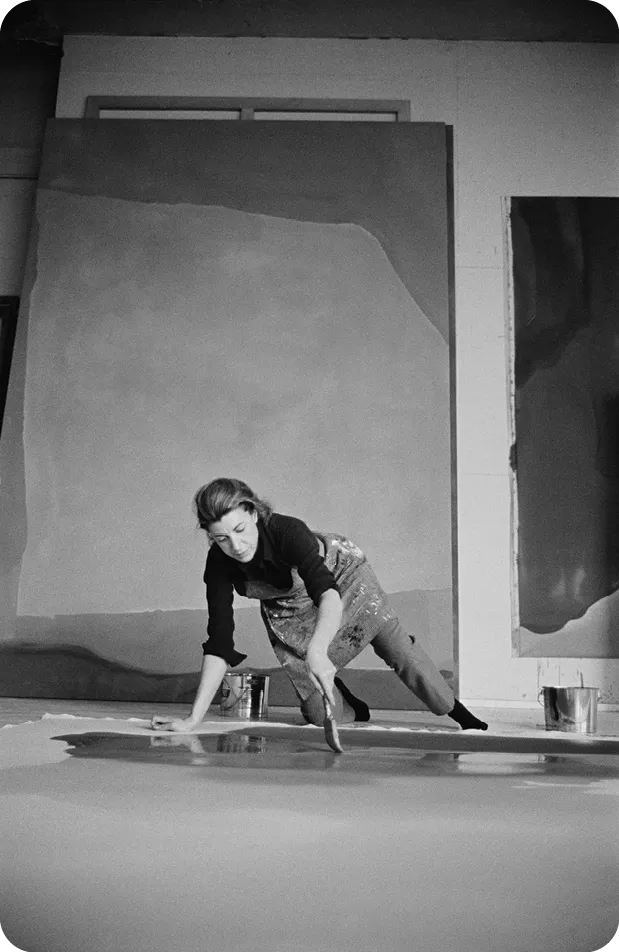
Painter Helen Frankenthaler in her studio, 1969.
Ressource affichée de l'autre côté.
Faites défiler pour voir la suite.
Faites défiler pour voir la suite.
PATH A
B1
1-A
Do you think “she” refers to one artist
or to women artists in general? Why?
2-A
Pick out the nouns and adjectives used
to describe her. Which emotions do they
convey?
3-A
What is implied by the use of these labels?
Ressource affichée de l'autre côté.
Faites défiler pour voir la suite.
Faites défiler pour voir la suite.
PATH B
B1+
1-B
Why does the author use the pronoun “she”? Is the
author talking about one woman in particular?
2-B
Pick out the expressions showing perseverance. Why
do you think the author emphasises these qualities?
3-B
How was the work of women artists received in the
art world?
Ressource affichée de l'autre côté.
Faites défiler pour voir la suite.
Faites défiler pour voir la suite.
Let's talk this out!
4
Sum up the difficulties faced by female artists according to the narrator.
5
Is the narrator's point of view objective or subjective? Use passages from the text to justify your answer.
6
How many female artists can you name? What about male artists? What can you deduce from that?
Ressource affichée de l'autre côté.
Faites défiler pour voir la suite.
Faites défiler pour voir la suite.
Letter to the museum visitors
The curator of the Tate Britain exhibition finds a mysterious letter written by one of the featured artists. On the envelope, it reads “To dear future visitors of my exhibition”. Write the letter, mentioning the artist's challenges, feelings, hopes or dreams for the art world.Une erreur sur la page ? Une idée à proposer ?
Nos manuels sont collaboratifs, n'hésitez pas à nous en faire part.
j'ai une idée !
Oups, une coquille