Vue papier

Découvrez la vue papier en cliquant ici
Unit 11
Activity 2
... or another battleground for science
Ressource affichée de l'autre côté.
Faites défiler pour voir la suite.
Faites défiler pour voir la suite.
ang1-unit11-activity2.mp3
Scientists around the world are looking for all kinds of ways to protect and maybe even revive corals. One option is to create more marine protected areas – essentially national parks in the ocean. Scientists say creating marine refuges, where fishing, mining, and recreating are off limits, make the reefs healthier, and so more resilient. […]
Beyond such nature preserves, some conservationists are looking to more hands-on methods. One research center in the Florida Keys is exploring a form of natural selection to keep corals afloat. […]
To keep the wild ecosystem alive, Muller and her team are harvesting samples of the corals that have survived the environmental stresses naturally, breeding them by hand, and reattaching them to the reef. […]
In the Bahamas, another research biologist at Chicago's Shedd Aquarium, is focusing on corals with robust genes that could make them natural candidates for restoration projects. He [studied] one that seemed to survive an intense 2015 heat wave, and one that didn't.
“It sets the stage to find out which genes are responsible for thermal tolerance,” says Cunning, adding that he hopes identifying those genes will help scientists one day breed more heat-tolerant coral. […]
Muller notes that their efforts on the Florida reefs can help keep them from what she describes as “functional extinction”. But she says the reefs ultimately won't be restored to their potential until their environment becomes more hospitable to their survival.
All the scientists interviewed for this article noted that mitigating climate change is the only long-term, sustainable solution to conserve and restore coral reefs.
Beyond such nature preserves, some conservationists are looking to more hands-on methods. One research center in the Florida Keys is exploring a form of natural selection to keep corals afloat. […]
To keep the wild ecosystem alive, Muller and her team are harvesting samples of the corals that have survived the environmental stresses naturally, breeding them by hand, and reattaching them to the reef. […]
In the Bahamas, another research biologist at Chicago's Shedd Aquarium, is focusing on corals with robust genes that could make them natural candidates for restoration projects. He [studied] one that seemed to survive an intense 2015 heat wave, and one that didn't.
“It sets the stage to find out which genes are responsible for thermal tolerance,” says Cunning, adding that he hopes identifying those genes will help scientists one day breed more heat-tolerant coral. […]
Muller notes that their efforts on the Florida reefs can help keep them from what she describes as “functional extinction”. But she says the reefs ultimately won't be restored to their potential until their environment becomes more hospitable to their survival.
All the scientists interviewed for this article noted that mitigating climate change is the only long-term, sustainable solution to conserve and restore coral reefs.
Ressource affichée de l'autre côté.
Faites défiler pour voir la suite.
Faites défiler pour voir la suite.

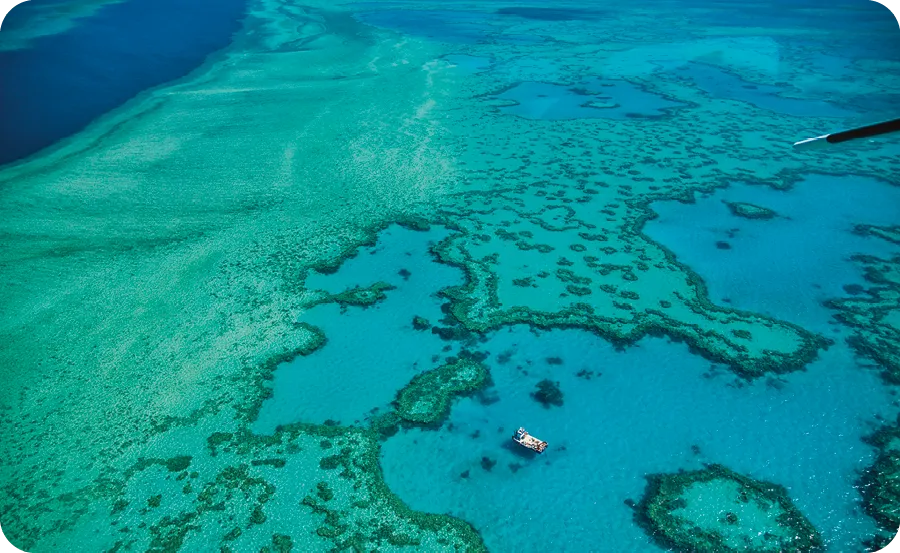
The Great Barrier Reef, Queensland, 2020.
Vidéo associée
From 0:00 to 1:48
Ressource affichée de l'autre côté.
Faites défiler pour voir la suite.
Faites défiler pour voir la suite.
PATH A
B1
1-A
Watch the video and pick out elements
showing coral reefs are suffering.
2-A
Explain what marine protected areas
are and how they help coral reefs.
3-A
Note down methods scientists are using to help
coral reefs survive (in the text and the video).
Ressource affichée de l'autre côté.
Faites défiler pour voir la suite.
Faites défiler pour voir la suite.
PATH B
B1+
1-B
Watch the video and find a major reason
why coral reefs are suffering.
2-B
In the text, find the two main approaches
for protecting coral reefs.
3-B
Find ways scientists are trying to protect
corals in the text and the video, and explain
the benefits of each method.
Ressource affichée de l'autre côté.
Faites défiler pour voir la suite.
Faites défiler pour voir la suite.
Let's talk this out!
4
In your opinion, which method seems to be the most effective for preserving coral reefs? Why?
5
Are these solutions sustainable? Why or why not?
6
What role do humans play in helping or harming coral reefs?
Ressource affichée de l'autre côté.
Faites défiler pour voir la suite.
Faites défiler pour voir la suite.
The Great Barrier Reef issue
National Geographic is preparing a special issue on the Great Barrier Reef. As a photojournalist, you have been asked to select the most powerful pictures and quotes to illustrate the magazine. Choose one picture and one quote, and be ready to explain and defend your choice. Don't forget to include the source and the date of your documents!Une erreur sur la page ? Une idée à proposer ?
Nos manuels sont collaboratifs, n'hésitez pas à nous en faire part.
j'ai une idée !
Oups, une coquille