Vue papier

Découvrez la vue papier en cliquant ici
Unit 13
Activity 1
Where it started, where it's going
Ressource affichée de l'autre côté.
Faites défiler pour voir la suite.
Faites défiler pour voir la suite.
1
A Dream of success or equality?
ang1-unit13-activity1.mp3
If you ask most people around the world what they mean by the “American dream,” nearly all will respond with some version of upward social mobility, the American success story, or the self-made man (rarely the self-made woman). Perhaps they will invoke the symbolic house with a white picket fence that suggests economic self-sufficiency and security; many will associate the phrase with the land of opportunity for immigrants. [...] The Oxford English Dictionary defines the American dream as “the ideal that every citizen of the United States should have an equal opportunity to achieve success and prosperity through hard work, determination, and initiative.” [...]
For Adams, worshipping material success was not the definition of the American dream: It was, by contrast, the failure of “the American dream of a better, richer, and happier life for all our citizens of every rank.” [...]
The American dream, according to Adams, was about collective moral character, [...] a “dream of social order,” in which every citizen could attain the best of which they were capable. [...]
It was the same American dream that Martin Luther King Jr. would call to service in the civil rights struggle in 1963, when he told white America that Black Americans shared that dream: “I still have a dream. It is a dream deeply rooted in the American dream. I have a dream that one day this nation will rise up and live out the true meaning of its creed: “We hold these truths to be self-evident, that all men are created equal...”
For Adams, worshipping material success was not the definition of the American dream: It was, by contrast, the failure of “the American dream of a better, richer, and happier life for all our citizens of every rank.” [...]
The American dream, according to Adams, was about collective moral character, [...] a “dream of social order,” in which every citizen could attain the best of which they were capable. [...]
It was the same American dream that Martin Luther King Jr. would call to service in the civil rights struggle in 1963, when he told white America that Black Americans shared that dream: “I still have a dream. It is a dream deeply rooted in the American dream. I have a dream that one day this nation will rise up and live out the true meaning of its creed: “We hold these truths to be self-evident, that all men are created equal...”
Ressource affichée de l'autre côté.
Faites défiler pour voir la suite.
Faites défiler pour voir la suite.
2
Belief in decline

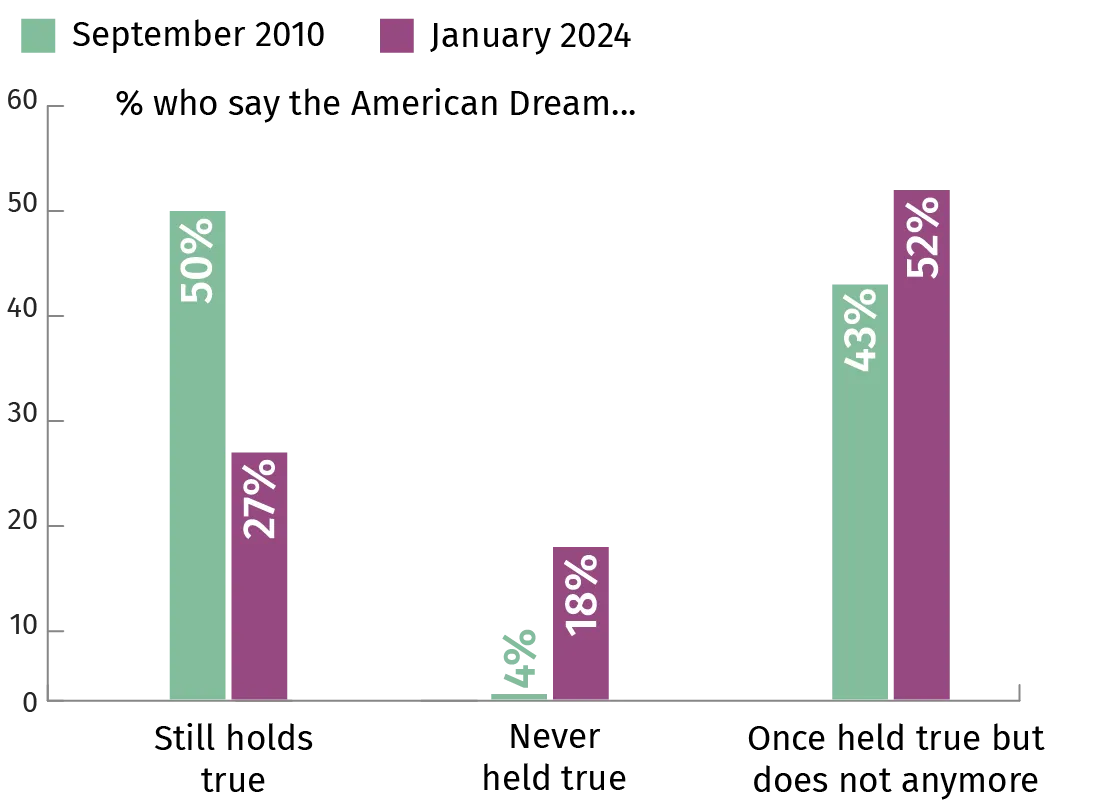
Adapted from: “American Dream far from reality for most people: POLL”, ABC News, 2024.
Ressource affichée de l'autre côté.
Faites défiler pour voir la suite.
Faites défiler pour voir la suite.
3
Leaving the dream


“Why Leaving the U.S. is the New American Dream”, Cyrus Janssen, 2024.
Vidéo associée
From 0:00 to 0:42Ressource affichée de l'autre côté.
Faites défiler pour voir la suite.
Faites défiler pour voir la suite.
Questions
1
What values or ideas are associated with the American Dream?
2
How has the American Dream evolved over time? Give examples from the three documents.
3
If fewer Americans believe in the Dream, do you think Canada could offer a different version? Why or why not?
Ressource affichée de l'autre côté.
Faites défiler pour voir la suite.
Faites défiler pour voir la suite.
Background check
In your own words, how would you define the American Dream today?Ressource affichée de l'autre côté.
Faites défiler pour voir la suite.
Faites défiler pour voir la suite.
Find words or expressions related to the idea of the American Dream in the text and sort them into the following categories: ideals - limits.
Une erreur sur la page ? Une idée à proposer ?
Nos manuels sont collaboratifs, n'hésitez pas à nous en faire part.
j'ai une idée !
Oups, une coquille