
Unit 5
Activity 2
The case for preservation
Ressource affichée de l'autre côté.
Faites défiler pour voir la suite.
Faites défiler pour voir la suite.
angt-unit5-activity2.mp3

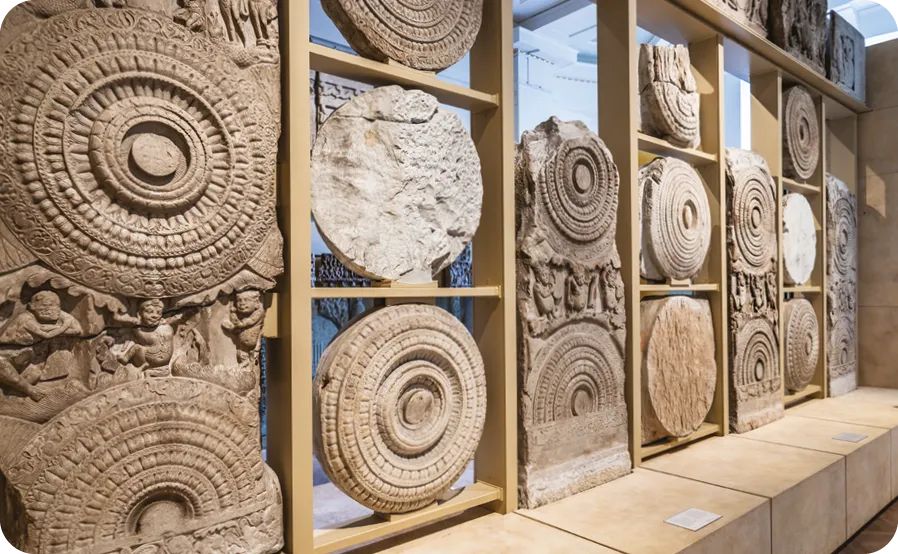
Ancient Buddhist Relief Carvings from Amaravathi at the British Museum, 2025.
Museums and galleries in Britain receive 120 million visitors each year. The British Museum alone draws 6.7 million annually. Hence, it is no coincidence that "encyclopaedic" museums (such as the British Museum and the Louvre) should highlight their cosmopolitan appeal.
What does being encyclopaedic have to do with colonialism? A lot, actually.
Museums assert that objects, regardless of where they came from or who claims them as their own, are held "in trust for the nation and the world", as the British Museum puts it. They are seen to belong to humanity as a whole.
By this token, repatriation claims by states and communities appear as [...] lesser possibilities that mustn't be entertained.
Herein lies the paradox of the modern museum; it wields the capacity to enhance both exclusion and access. An object can be viewed but never owned. [...]
The discourse on global custodianship makes its way down from powerful institutions (such as the Bizot Group, a powerful clique of 40 museums) to inform how cultural property should be displayed.
The group adopted, in 2002, the Declaration on the Importance and Value of Universal Museums, underscoring that "museums serve not just the citizens of one nation but the people of every nation". This notion of shared heritage allows them to deflect attention from the historical context in which the objects were extracted.
But common heritage has also become a reason to share. Travelling exhibitions, such as "India and the World," work on the assumption that the world could, and must, be made interconnected through the circulation of objects. [...]
British Museum director Hartwig Fischer observed in his foreword to the exhibition catalogue that "As a museum of the world, for the world, the British Museum can play an important role in working together with partners across the globe to tell such stories."
What does being encyclopaedic have to do with colonialism? A lot, actually.
Museums assert that objects, regardless of where they came from or who claims them as their own, are held "in trust for the nation and the world", as the British Museum puts it. They are seen to belong to humanity as a whole.
By this token, repatriation claims by states and communities appear as [...] lesser possibilities that mustn't be entertained.
Herein lies the paradox of the modern museum; it wields the capacity to enhance both exclusion and access. An object can be viewed but never owned. [...]
The discourse on global custodianship makes its way down from powerful institutions (such as the Bizot Group, a powerful clique of 40 museums) to inform how cultural property should be displayed.
The group adopted, in 2002, the Declaration on the Importance and Value of Universal Museums, underscoring that "museums serve not just the citizens of one nation but the people of every nation". This notion of shared heritage allows them to deflect attention from the historical context in which the objects were extracted.
But common heritage has also become a reason to share. Travelling exhibitions, such as "India and the World," work on the assumption that the world could, and must, be made interconnected through the circulation of objects. [...]
British Museum director Hartwig Fischer observed in his foreword to the exhibition catalogue that "As a museum of the world, for the world, the British Museum can play an important role in working together with partners across the globe to tell such stories."
Ressource affichée de l'autre côté.
Faites défiler pour voir la suite.
Faites défiler pour voir la suite.
PATH A
B1
1-A
How do you understand the term
"encyclopaedic" museum?
2-A
Pick out quotes saying that the objects
displayed belong to everyone.
3-A
Why are travelling exhibitions presented
as a positive solution?
Ressource affichée de l'autre côté.
Faites défiler pour voir la suite.
Faites défiler pour voir la suite.
PATH B
B2
1-B
Identify arguments that museums give for keeping
the objects whatever their country of origin.
2-B
Why do repatriation claims appear to be "lesser
possibilities" by this logic?
3-B
What problem does the author point out in this
vision of a "museum of the world"?
Ressource affichée de l'autre côté.
Faites défiler pour voir la suite.
Faites défiler pour voir la suite.
Let's talk this out!
4
Share your findings. Sum up the main arguments museums use to keep artefacts and the solutions they envision.
5
How convincing is the idea of a "museum of the world" to you? Would you agree with it?
Ressource affichée de l'autre côté.
Faites défiler pour voir la suite.
Faites défiler pour voir la suite.
Take part in a discussion panel.
You are a member of an international youth panel at a UNESCO forum on Museum Ethics and Cultural Heritage. Prepare short arguments to take part in the debate. Then act it out: present your points, respond to arguments, and try to convince the audience.
You are a member of an international youth panel at a UNESCO forum on Museum Ethics and Cultural Heritage. Prepare short arguments to take part in the debate. Then act it out: present your points, respond to arguments, and try to convince the audience.
Une erreur sur la page ? Une idée à proposer ?
Nos manuels sont collaboratifs, n'hésitez pas à nous en faire part.
j'ai une idée !
Oups, une coquille