Case Study 3
Axe 2
Objet d'étude 3
Sawubona! The legacy of Constitution Hill
Ressource affichée de l'autre côté.
Faites défiler pour voir la suite.
Faites défiler pour voir la suite.
Write a page for Lonely Planet.
You are one of the authors of the Lonely Planet guide. Your mission is to create a page for the e-book guide on Constitution Hill to show South Africans' ability to face their painful past and turn it into a new beginning. You will write about its history and show how art is now used to heal the country's wounds. Your words should make readers want to visit the site, but also understand the emotions it holds.
You are one of the authors of the Lonely Planet guide. Your mission is to create a page for the e-book guide on Constitution Hill to show South Africans' ability to face their painful past and turn it into a new beginning. You will write about its history and show how art is now used to heal the country's wounds. Your words should make readers want to visit the site, but also understand the emotions it holds.


Ressource affichée de l'autre côté.
Faites défiler pour voir la suite.
Faites défiler pour voir la suite.
1
A long walk to freedom
angt-cs3-step1.mp3
Constitution Hill is a living museum that tells the story of South Africa's journey to democracy. The site is a former prison and military fort that bears testament to South Africa's turbulent past and, today, is home to the country's Constitutional Court, which endorses the rights of all citizens.
There is perhaps no other site of incarceration in South Africa that imprisoned the sheer number of world-renowned men and women as those held within the walls of the Old Fort, the Women's Jail and Number Four. Nelson Mandela. Mahatma Gandhi. Joe Slovo. Albertina Sisulu. Winnie Madikizela-Mandela. Fatima Meer. They all served time here. But the precinct also confined tens of thousands of ordinary people during its 100-year history: men and women of all races, creeds, ages and political agendas; the indigenous and the immigrant; the everyman and the elite. In this way, the history of every South African lives here.
Constitution Hill is also a place of contrasts: of injustice and justice, of oppression and liberation. Our precinct is testament to the importance of preserving sites of atrocity for posterity, and also to recreating them so that they can serve the purposes of the present and serve to mould the future.
There is perhaps no other site of incarceration in South Africa that imprisoned the sheer number of world-renowned men and women as those held within the walls of the Old Fort, the Women's Jail and Number Four. Nelson Mandela. Mahatma Gandhi. Joe Slovo. Albertina Sisulu. Winnie Madikizela-Mandela. Fatima Meer. They all served time here. But the precinct also confined tens of thousands of ordinary people during its 100-year history: men and women of all races, creeds, ages and political agendas; the indigenous and the immigrant; the everyman and the elite. In this way, the history of every South African lives here.
Constitution Hill is also a place of contrasts: of injustice and justice, of oppression and liberation. Our precinct is testament to the importance of preserving sites of atrocity for posterity, and also to recreating them so that they can serve the purposes of the present and serve to mould the future.
Ressource affichée de l'autre côté.
Faites défiler pour voir la suite.
Faites défiler pour voir la suite.

Vidéo associée
Ressource affichée de l'autre côté.
Faites défiler pour voir la suite.
Faites défiler pour voir la suite.
Sawubona is a Zulu greeting meaning “I see you”. More than words of politeness, sawubona carries the importance of recognising the worth and dignity of each person.
Ressource affichée de l'autre côté.
Faites défiler pour voir la suite.
Faites défiler pour voir la suite.
Step 1
1
Read the text. What was Constitution Hill in the past? And today?
2
Name famous people who were incarcerated there and explain who they were in a few words. Go online to complete your findings, if needed.
3
Watch the video. Pick out dates and names related to the Women's Jail.
4
What crimes did the convicts commit?
Action!
As a Lonely Planet writer, you need to get your facts straight! Create a timeline of key events related to Constitution Hill and choose some historical figures to integrate.
Ressource affichée de l'autre côté.
Faites défiler pour voir la suite.
Faites défiler pour voir la suite.
2
Art as a witness
angt-cs3-step2.mp3
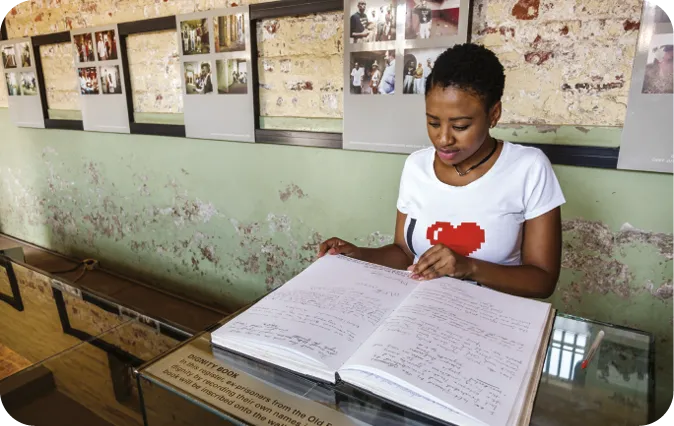
The exhibition, titled Prison Diaries after her book by the same name, showcases anti-apartheid activist Fatima Meer's artwork during her incarceration in 1976. She was detained in solitary confinement in Women's Jail (now part of the Constitution Hill complex) along with ten members of the Black Women's Federation, an organisation banned by the apartheid government.
According to the accompanying statement, Prison Diary “captures some of the day-to-day stories and private moments of women who were detained and imprisoned during the liberation struggle of South Africa.” And on the opening night, it was stark how there was a presence of black women who were not strictly defined as political prisoners, but were confined to the Women's Prison. […]
The paintings stand out in their brilliant colouring. How did Meer manage to smuggle these colours into the prison? Meer answers through a description on a series of paintings called The Cells. “In the beginning, there was only the ballpoint pen,” she said. “Later I was allowed ballpoints of different colours. And later still came poster paint, with the strict instructions that I could paint only flowers.”
According to the accompanying statement, Prison Diary “captures some of the day-to-day stories and private moments of women who were detained and imprisoned during the liberation struggle of South Africa.” And on the opening night, it was stark how there was a presence of black women who were not strictly defined as political prisoners, but were confined to the Women's Prison. […]
The paintings stand out in their brilliant colouring. How did Meer manage to smuggle these colours into the prison? Meer answers through a description on a series of paintings called The Cells. “In the beginning, there was only the ballpoint pen,” she said. “Later I was allowed ballpoints of different colours. And later still came poster paint, with the strict instructions that I could paint only flowers.”
Ressource affichée de l'autre côté.
Faites défiler pour voir la suite.
Faites défiler pour voir la suite.
Step 2
1
Who was Fatima Meer, and why was she incarcerated at Constitution Hill?
2
What does the Prison Diaries exhibition focus on?
3
How did she manage to create art while in prison, and what does this reveal about her?
Action!
Create an “Art Spotlight” section for your guide page. Choose one of Fatima Meer's artworks and write a short piece about it.
Ressource affichée de l'autre côté.
Faites défiler pour voir la suite.
Faites défiler pour voir la suite.
3 Tribute to visionary leaders
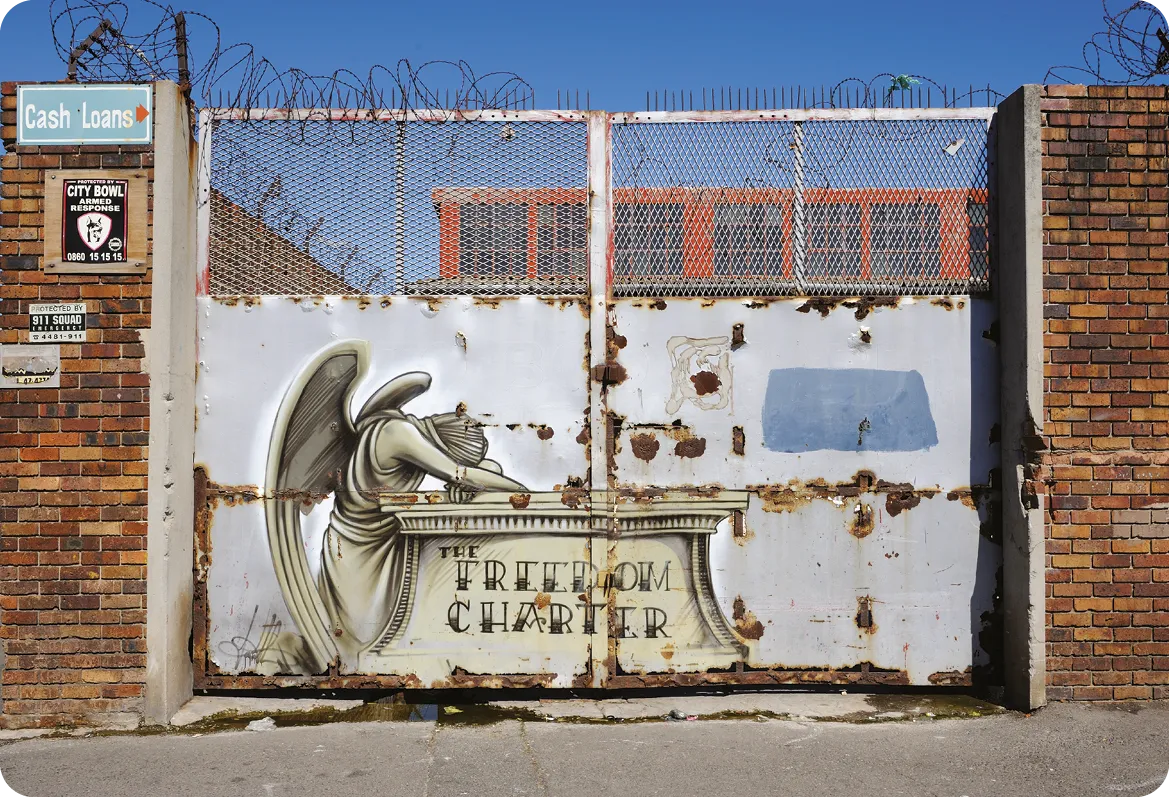
Painting by South African painter Faith 47, Cape Town, 2017.
Vidéo associée
From 0:00 to 2:15Ressource affichée de l'autre côté.
Faites défiler pour voir la suite.
Faites défiler pour voir la suite.
Step 3
1
What is the purpose of the Freedom Charter?
2
Describe the artworks. What is their connection to the charter?
3
Sum up how the exhibition connects history with the present.
Action!
Write a Visitor Tip paragraph for the Portraits of Legacy exhibition. Give readers reasons not to miss this powerful experience.
Ressource affichée de l'autre côté.
Faites défiler pour voir la suite.
Faites défiler pour voir la suite.
Ready...
- Gather your notes, select the elements of Constitution Hill's history that you want to highlight, and outline the sections you want to include in your page.
Steady...
- Find a catchy title.
- Select artworks and photos to illustrate the page.
- Organise your sections (text blocks, images) on paper or on a digital template.
Go!
- Write your page, filling all the boxes with compelling text to convince your readers that Constitution Hill is worth visiting.
Une erreur sur la page ? Une idée à proposer ?
Nos manuels sont collaboratifs, n'hésitez pas à nous en faire part.
j'ai une idée !
Oups, une coquille