Vue papier
Découvrez la vue papier en cliquant ici
Unit 7
Book Club
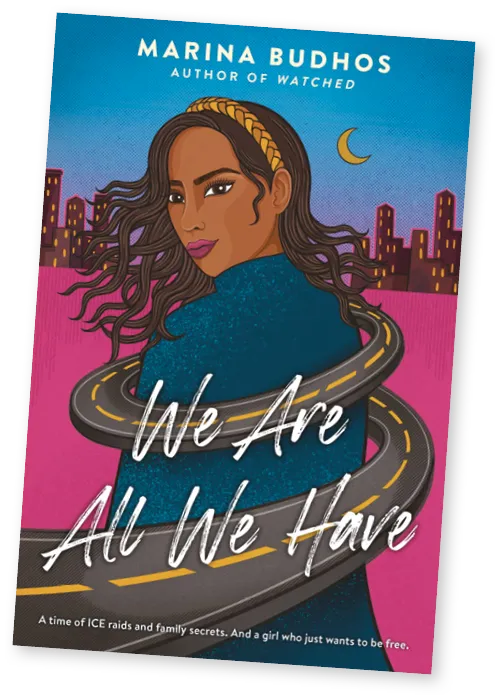
We Are All We Have
Ressource affichée de l'autre côté.
Faites défiler pour voir la suite.
Faites défiler pour voir la suite.
In We Are All We Have, Marina Budhos tells the story of Rania, a 17-year-old
Pakistani asylum seeker living in Brooklyn whose life is upended when her mother
is detained by U.S. immigration authorities. Left alone with her younger brother,
Rania is placed in a shelter where she meets Carlos, a Mexican teen. Together, they
escape and take to the road, beginning a journey across the U.S. that forces Rania
to confront family secrets, questions of identity, and the meaning of belonging.
Ressource affichée de l'autre côté.
Faites défiler pour voir la suite.
Faites défiler pour voir la suite.
Texte
We Are All We Have
Our FREEDOM T-shirts came from when we were studying the Beats with Mr. D junior year and reading Jack Kerouac's On the Road. I complained that the main characters are just a bunch of sexist white dudes who get to do whatever they want, and all the women are called girls and get dumped. “Go ahead, rewrite it,” he told us.
So I did. We performed our feminist version for Mr. D's Beat Café Night. Brooklyn Ra-Ra and Fa-Fa, we called ourselves. We sat on folding chairs, in black felt berets, on our own wild road trip to find America. At the end I got up and gave my last riff:
The road is a licorice whip sliding down my throat
red-bean buns in Sunset Park, watching the sky blush pink.
West, go West, the Beats told us.
What if the road isn't yours because the guys got there first?
Maybe the road is your head bristling with possibilities,
The America of me
not the Mexican girl left behind in California,
the jazz players of Denver.
We want America too but our mothers say:
Be careful. Watch out. Curb your mouth. Bring in the laundry.
How do you find America when you've got dinner to make?
When you can't kiss that boy under a Red Hook moon?
I am not my mother I am me
How do I find the America that is me?
We got a lot of cheers, some howling, kids punching the air. Mr. D submitted that and some of my other writing to a contest. I won a scholarship for “literary promise,” which will help pay for Hunter College. Meanwhile, Fatima fought with her parents to go to FIT, the Fashion Institute of Technology, but her father put his foot down and said she was going to Brooklyn College, since it's closer to home, and she'll major in something more practical. Still we made promises to meet up in Prospect Park or rove around the city as much as we could.
Our version of free. [...]
“She was refused her stay,” Lidia, our lawyer, states, leaning forward on her desk. It's the morning after the ICE raid, and I'm in Lidia's office. [...]
“A few weeks ago we found out her stay had been denied. I don't think she was expecting that.” [...]
“Can I see her?” My voice cracks.
“That's what I'm working on. They have her in a facility in Pennsylvania.”
“Pennsylvania!” I can barely breathe.
“I can't say whether that's better or worse. My clients who go to Elizabeth, New Jersey, right next to Newark Airport, are put on a plane home.”
Home? Ammi often says, I would sooner die than step back into that country that took your father. [...]
It's so green once Lidia and I leave the city, the road like a hungry tongue, lapping up trees. Bushes foam at the sides. All this air and glaring light rushing through the windshield. How can there be so much beauty when my mother is locked up in some detention center? I hate all of it – the green fields, the wide highway, the occasional flag stabbing the big sky. That's what had us fooled about this country. We sang it at school for assembly: This land is your land, this land is my land/From California to the New York island… I believed it, as did Ammi. I remember once we were driving to Bear Mountain and she said, “How beautiful! This place is settler country.”
“Ammi!” I cried. “You're identifying with genocidal colonizers?”
She gave me a sharp look. “All I'm saying is this is a big country. Vast. Not a place of corruption and bribes. They'll find room for us”
“‘We're pointed toward the American continent,’” I quoted.
“What was that?”
“Just a book.”
So I did. We performed our feminist version for Mr. D's Beat Café Night. Brooklyn Ra-Ra and Fa-Fa, we called ourselves. We sat on folding chairs, in black felt berets, on our own wild road trip to find America. At the end I got up and gave my last riff:
The road is a licorice whip sliding down my throat
red-bean buns in Sunset Park, watching the sky blush pink.
West, go West, the Beats told us.
What if the road isn't yours because the guys got there first?
Maybe the road is your head bristling with possibilities,
The America of me
not the Mexican girl left behind in California,
the jazz players of Denver.
We want America too but our mothers say:
Be careful. Watch out. Curb your mouth. Bring in the laundry.
How do you find America when you've got dinner to make?
When you can't kiss that boy under a Red Hook moon?
I am not my mother I am me
How do I find the America that is me?
We got a lot of cheers, some howling, kids punching the air. Mr. D submitted that and some of my other writing to a contest. I won a scholarship for “literary promise,” which will help pay for Hunter College. Meanwhile, Fatima fought with her parents to go to FIT, the Fashion Institute of Technology, but her father put his foot down and said she was going to Brooklyn College, since it's closer to home, and she'll major in something more practical. Still we made promises to meet up in Prospect Park or rove around the city as much as we could.
Our version of free. [...]
“She was refused her stay,” Lidia, our lawyer, states, leaning forward on her desk. It's the morning after the ICE raid, and I'm in Lidia's office. [...]
“A few weeks ago we found out her stay had been denied. I don't think she was expecting that.” [...]
“Can I see her?” My voice cracks.
“That's what I'm working on. They have her in a facility in Pennsylvania.”
“Pennsylvania!” I can barely breathe.
“I can't say whether that's better or worse. My clients who go to Elizabeth, New Jersey, right next to Newark Airport, are put on a plane home.”
Home? Ammi often says, I would sooner die than step back into that country that took your father. [...]
It's so green once Lidia and I leave the city, the road like a hungry tongue, lapping up trees. Bushes foam at the sides. All this air and glaring light rushing through the windshield. How can there be so much beauty when my mother is locked up in some detention center? I hate all of it – the green fields, the wide highway, the occasional flag stabbing the big sky. That's what had us fooled about this country. We sang it at school for assembly: This land is your land, this land is my land/From California to the New York island… I believed it, as did Ammi. I remember once we were driving to Bear Mountain and she said, “How beautiful! This place is settler country.”
“Ammi!” I cried. “You're identifying with genocidal colonizers?”
She gave me a sharp look. “All I'm saying is this is a big country. Vast. Not a place of corruption and bribes. They'll find room for us”
“‘We're pointed toward the American continent,’” I quoted.
“What was that?”
“Just a book.”
Ressource affichée de l'autre côté.
Faites défiler pour voir la suite.
Faites défiler pour voir la suite.
United States ICE (Immigration and Customs Enforcement) is the federal agency in charge of enforcing immigration laws inside the U.S. In recent years, its actions have sparked national debate and protests, especially since the start of 2026, when violent enforcement operations began raising serious concerns. The events in We Are All We Have take place before these developments, but they connect to the long-standing issues surrounding immigration enforcement in the U.S.
Ressource affichée de l'autre côté.
Faites défiler pour voir la suite.
Faites défiler pour voir la suite.
a) Why does the
narrator criticize
On the Road and its
male characters?
Ressource affichée de l'autre côté.
Faites défiler pour voir la suite.
Faites défiler pour voir la suite.
b) What did the
students create for
“Beat Café Night”?
Ressource affichée de l'autre côté.
Faites défiler pour voir la suite.
Faites défiler pour voir la suite.
c) What is
the narrator's
“feminist version”
of the road about?
Ressource affichée de l'autre côté.
Faites défiler pour voir la suite.
Faites défiler pour voir la suite.
d) How do Rania and
Fatima find freedom?
Ressource affichée de l'autre côté.
Faites défiler pour voir la suite.
Faites défiler pour voir la suite.
e) What news does
Lidia give Rania about
her mother's situation?
Ressource affichée de l'autre côté.
Faites défiler pour voir la suite.
Faites défiler pour voir la suite.
f) Where is Rania's
mother taken?
Ressource affichée de l'autre côté.
Faites défiler pour voir la suite.
Faites défiler pour voir la suite.
g) How does Rania feel
about the landscape?
Ressource affichée de l'autre côté.
Faites défiler pour voir la suite.
Faites défiler pour voir la suite.
h) How do Rania and
her mother's views
about America differ?
Ressource affichée de l'autre côté.
Faites défiler pour voir la suite.
Faites défiler pour voir la suite.
Marina Budhos is a Queens-born author who taught literature for years
at William Paterson University. Her novels Ask Me No Questions, Watched,
The Long Ride, and We Are All We Have frequently depict characters on
journeys, both physically across American landscapes, and emotionally
across cultural divides. Budhos has been granted fellowships from
the NEA (National Endowment for the Arts) and New Jersey's Council
on the Arts, a Rona Jaffe Award, and several literary honors.


Ressource affichée de l'autre côté.
Faites défiler pour voir la suite.
Faites défiler pour voir la suite.
Journal from the road
Rania is travelling with Lidia to Pennsylvania, and everything she sees on the road feels beautiful and painful at the same time. Imagine what she would write in her journal. Describe the landscape she is driving through, her mixed feelings about America, and what she wishes she could say to her mother.
Rania is travelling with Lidia to Pennsylvania, and everything she sees on the road feels beautiful and painful at the same time. Imagine what she would write in her journal. Describe the landscape she is driving through, her mixed feelings about America, and what she wishes she could say to her mother.
Une erreur sur la page ? Une idée à proposer ?
Nos manuels sont collaboratifs, n'hésitez pas à nous en faire part.
j'ai une idée !
Oups, une coquille