Vue papier
Découvrez la vue papier en cliquant ici
Unit B
Activity 3
Inspired by literature
Ressource affichée de l'autre côté.
Faites défiler pour voir la suite.
Faites défiler pour voir la suite.
Group 1Taught by AI
Group 1
Ressource affichée de l'autre côté.
Faites défiler pour voir la suite.
Faites défiler pour voir la suite.
Every time I read about another advance in AI technology, I feel like another figment of science fiction moves closer to reality. Lately, I've been noticing eerie parallels to Neal Stephenson's 1995 novel The Diamond Age: Or, A Young Lady's Illustrated Primer. [...]
In Stephenson's novel, the Primer looks like a hardcover book, but each of its “pages” is really a screen display that can show animations and text, and it responds to its user in real time via AI. The book also has an audio component, which voices the characters and narrates stories being told by the device.
It was originally created for the young daughter of an aristocrat, but it accidentally falls into the hands of a girl named Nell who's living on the streets of a futuristic Shanghai. The Primer provides Nell personalized emotional, social and intellectual support during her journey to adulthood, serving alternatively as an AI companion, a storyteller, a teacher and a surrogate parent. [...] In The Diamond Age, the Primer doesn't simply weave interactive fairy tales for Nell. It also assumes the responsibility of educating her on everything from her ABCs when younger to the intricacies of cryptography and politics as she gets older.
It's no secret that AI tools, such as ChatGPT, are now being widely used by both teachers and students. [...] There are certainly advantages to AI tutors: Tutoring and college tuition can be exorbitantly expensive, and the technology can offer better access to education to people of all income levels. [...]
But The Diamond Age offers a warning, too. [...] While large-scale deployment of a Primer-like AI could certainly make young people smarter and more efficient, it could also hamper one of the most important parts of education: teaching people to think for themselves.
In Stephenson's novel, the Primer looks like a hardcover book, but each of its “pages” is really a screen display that can show animations and text, and it responds to its user in real time via AI. The book also has an audio component, which voices the characters and narrates stories being told by the device.
It was originally created for the young daughter of an aristocrat, but it accidentally falls into the hands of a girl named Nell who's living on the streets of a futuristic Shanghai. The Primer provides Nell personalized emotional, social and intellectual support during her journey to adulthood, serving alternatively as an AI companion, a storyteller, a teacher and a surrogate parent. [...] In The Diamond Age, the Primer doesn't simply weave interactive fairy tales for Nell. It also assumes the responsibility of educating her on everything from her ABCs when younger to the intricacies of cryptography and politics as she gets older.
It's no secret that AI tools, such as ChatGPT, are now being widely used by both teachers and students. [...] There are certainly advantages to AI tutors: Tutoring and college tuition can be exorbitantly expensive, and the technology can offer better access to education to people of all income levels. [...]
But The Diamond Age offers a warning, too. [...] While large-scale deployment of a Primer-like AI could certainly make young people smarter and more efficient, it could also hamper one of the most important parts of education: teaching people to think for themselves.
Ressource affichée de l'autre côté.
Faites défiler pour voir la suite.
Faites défiler pour voir la suite.
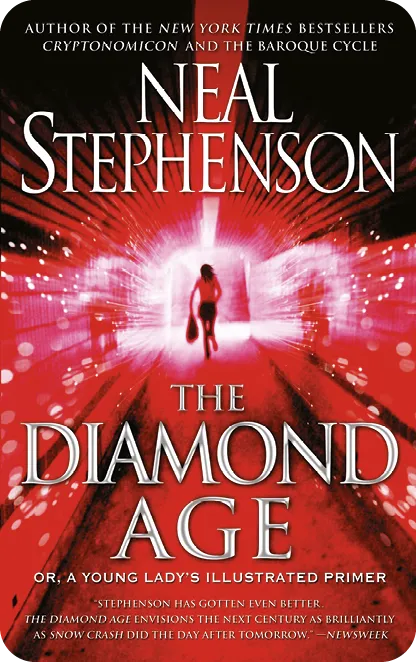
The Diamond Age, Neal Stephenson, 1995.
Ressource affichée de l'autre côté.
Faites défiler pour voir la suite.
Faites défiler pour voir la suite.
Questions
You are in charge of one text.
1
Pick out information about the novel and author, then describe the main plot. You may go online to complete your findings.
2
Describe the technology imagined in the novel. What real-life scientific advances can you connect it to?
3
Does the novel inspire, influence, or resemble real-life science and technology? In what ways?
Let's talk this out!
4
Present your document and compare the three novels: How do the imagined technologies differ in purpose, scope, and impact?
5
What ethical, social, or practical questions do these technologies raise?
6
In your opinion, which of the novels has been the most influential for scientific progress? Why?
Ressource affichée de l'autre côté.
Faites défiler pour voir la suite.
Faites défiler pour voir la suite.
In pairs, pick one
technology you
have read about.
Then, argue for or
against it being
a good invention.
Ressource affichée de l'autre côté.
Faites défiler pour voir la suite.
Faites défiler pour voir la suite.
Retrouvez des fiches activité pour chaque groupe.
Ressource affichée de l'autre côté.
Faites défiler pour voir la suite.
Faites défiler pour voir la suite.
Pitch your sci-fi story.
Your school organises a sci-fi short story contest. Write a short pitch for a story that could inspire future technology. Describe the plot, setting and characters, and explain how your idea could inspire scientific research or innovation.
Your school organises a sci-fi short story contest. Write a short pitch for a story that could inspire future technology. Describe the plot, setting and characters, and explain how your idea could inspire scientific research or innovation.
Une erreur sur la page ? Une idée à proposer ?
Nos manuels sont collaboratifs, n'hésitez pas à nous en faire part.
j'ai une idée !
Oups, une coquille