Vue papier

Découvrez la vue papier en cliquant ici
Case Study 6
Axe 3
Objet d'étude 2
Jane Austen, revisited: social rules then and now
Ressource affichée de l'autre côté.
Faites défiler pour voir la suite.
Faites défiler pour voir la suite.
Take part in a #ModernManners Challenge.
You are participating in an online creative challenge that reimagines classic “novels of manners” for the 21st century. Your task is to write a short scene that captures how unwritten social rules shape relationships today (just as Austen did for her era). Think about how money, social status, reputation, or family pressure influence the way people meet, communicate, judge each other, or fall in love. Use dialogue, irony, and sharp observation to reveal these modern “manners”.

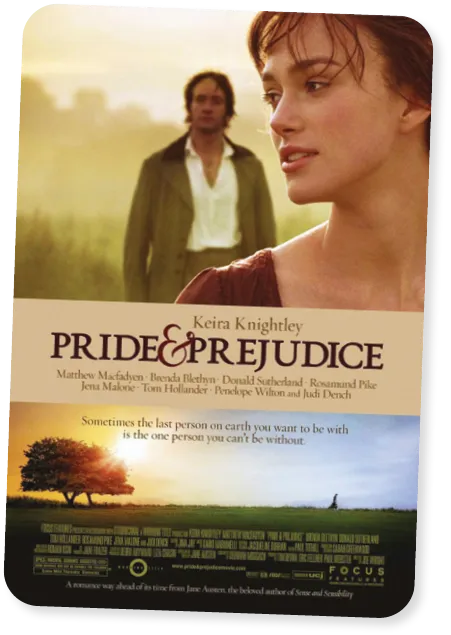
Poster for Pride & Prejudice, adapted from Jane Austen's classic novel, 2005.
You are participating in an online creative challenge that reimagines classic “novels of manners” for the 21st century. Your task is to write a short scene that captures how unwritten social rules shape relationships today (just as Austen did for her era). Think about how money, social status, reputation, or family pressure influence the way people meet, communicate, judge each other, or fall in love. Use dialogue, irony, and sharp observation to reveal these modern “manners”.
Poster for Pride & Prejudice, adapted from Jane Austen's classic novel, 2005.
Vidéo associée
Ressource affichée de l'autre côté.
Faites défiler pour voir la suite.
Faites défiler pour voir la suite.
1
A truth universally acknowledged
angt-cs6-step1.mp3
It is a truth universally acknowledged, that a single man in possession of a good fortune, must be in want of a wife. [...]
“My dear Mr. Bennet,” said his lady to him one day, “have you heard that Netherfield Park is let at last?”
Mr. Bennet replied that he had not.
“But it is,” returned she; “for Mrs. Long has just been here, and she told me all about it.”
Mr. Bennet made no answer.
“Do not you want to know who has taken it?” cried his wife impatiently.
“You want to tell me, and I have no objection to hearing it.”
This was invitation enough.
“Why, my dear, you must know, Mrs. Long says that Netherfield is taken by a young man of large fortune from the north of England; that he came down on Monday in a chaise and four to see the place, and was so much delighted with it, that he agreed with Mr. Morris immediately; that he is to take possession before Michaelmas, and some of his servants are to be in the house by the end of next week.”
“What is his name?”
“Bingley.”
“Is he married or single?”
“Oh! single, my dear, to be sure! A single man of large fortune; four or five thousand a year. What a fine thing for our girls!”
“How so? how can it affect them?”
“My dear Mr. Bennet,” replied his wife, “how can you be so tiresome! You must know that I am thinking of his marrying one of them.”
“My dear Mr. Bennet,” said his lady to him one day, “have you heard that Netherfield Park is let at last?”
Mr. Bennet replied that he had not.
“But it is,” returned she; “for Mrs. Long has just been here, and she told me all about it.”
Mr. Bennet made no answer.
“Do not you want to know who has taken it?” cried his wife impatiently.
“You want to tell me, and I have no objection to hearing it.”
This was invitation enough.
“Why, my dear, you must know, Mrs. Long says that Netherfield is taken by a young man of large fortune from the north of England; that he came down on Monday in a chaise and four to see the place, and was so much delighted with it, that he agreed with Mr. Morris immediately; that he is to take possession before Michaelmas, and some of his servants are to be in the house by the end of next week.”
“What is his name?”
“Bingley.”
“Is he married or single?”
“Oh! single, my dear, to be sure! A single man of large fortune; four or five thousand a year. What a fine thing for our girls!”
“How so? how can it affect them?”
“My dear Mr. Bennet,” replied his wife, “how can you be so tiresome! You must know that I am thinking of his marrying one of them.”
Ressource affichée de l'autre côté.
Faites défiler pour voir la suite.
Faites défiler pour voir la suite.

Vidéo associée
From 0:00 to 4:04Ressource affichée de l'autre côté.
Faites défiler pour voir la suite.
Faites défiler pour voir la suite.
Step 1
1
Watch the trailer of the film adaptation of Pride and Prejudice. Identify the characters and plot.
2
What does the first sentence of the novel suggest about marriage in Jane Austen's society?
3
Find references to the themes of social status and class in the text.
4
Watch the video. In what ways do social rules and money shape the characters' relationships, beyond romance?
Action!
Write your own “universal truth”: Rewrite the first sentence of Pride and Prejudice. Keep its structure but apply it to a modern topic of your choice (meeting someone, dating, career expectations, etc.).
Ressource affichée de l'autre côté.
Faites défiler pour voir la suite.
Faites défiler pour voir la suite.
2
Money, power... and love?


Still from the TV series Normal People, adapted from Sally Rooney's novel.
Vidéo associée
Ressource affichée de l'autre côté.
Faites défiler pour voir la suite.
Faites défiler pour voir la suite.
Step 2
1
What do we learn about the characters' backgrounds in this extract?
2
Why does Connell say that money makes the world “real”?
3
How does getting a scholarship affect Connell's social position?
Action!
Create ID cards for two characters with contrasting backgrounds or values. Include their age, social status, personality, ambitions, and fears.
Ressource affichée de l'autre côté.
Faites défiler pour voir la suite.
Faites défiler pour voir la suite.
3
Rooney: “The Jane Austen of the precariat”
Characters that struggle with their identities – and the way they interact in larger social frameworks – are author Sally Rooney's specialty. [...]
She resembles Jane Austen in this respect; in fact, she even said in an interview with The New Yorker that “a lot of critics have noticed that my books are basically nineteenth-century novels dressed up in contemporary clothing.”
(She) reinvented the novel-of-manners for the digital era, bringing her own fresh voice and a new dimension of complexity that examines moral ambiguity with unparalleled clarity. As Swetabh Changkakoti '24 wrote in a message to The Herald, her books are “grounded in our generation's reality. People fumble and mess up, digital communication is a real thing, and I think her descriptions have the power to materialize connections between people characteristically disconnected from themselves.”
But that's not the only reason Rooney has become a cultural phenomenon: Just as digital technology seamlessly becomes a part of her narrative, the social and political atmosphere of the times are absorbed into it just as naturally. The 2008 financial crash of Ireland forms the backdrop of both her novels; Normal People explicitly highlights class differences.
She resembles Jane Austen in this respect; in fact, she even said in an interview with The New Yorker that “a lot of critics have noticed that my books are basically nineteenth-century novels dressed up in contemporary clothing.”
(She) reinvented the novel-of-manners for the digital era, bringing her own fresh voice and a new dimension of complexity that examines moral ambiguity with unparalleled clarity. As Swetabh Changkakoti '24 wrote in a message to The Herald, her books are “grounded in our generation's reality. People fumble and mess up, digital communication is a real thing, and I think her descriptions have the power to materialize connections between people characteristically disconnected from themselves.”
But that's not the only reason Rooney has become a cultural phenomenon: Just as digital technology seamlessly becomes a part of her narrative, the social and political atmosphere of the times are absorbed into it just as naturally. The 2008 financial crash of Ireland forms the backdrop of both her novels; Normal People explicitly highlights class differences.
Ressource affichée de l'autre côté.
Faites défiler pour voir la suite.
Faites défiler pour voir la suite.
Step 3
1
Which social issues does Rooney explore in her novels?
2
In what ways do Rooney's themes resemble Austen's?
3
Rooney is sometimes called “the Jane Austen of the precariat”. What is the “precariat”? Why is this nickname important to understand her work?
Action!
Write the synopsis of your scene: Describe a contemporary situation (in school, online, etc.) where social class creates tension or misunderstanding between two characters.
Ressource affichée de l'autre côté.
Faites défiler pour voir la suite.
Faites défiler pour voir la suite.
Ready...
- Identify one modern social code or expectation: popularity at school, online reputation, family pressure, etc.
Steady...
- Imagine a situation where your two characters' social worlds collide: first meeting at a party, a group project at school, a college admission discussion, etc.
Go!
- Write your scene! Include an opening “universal truth” that sets the social context, a dialogue between your two characters, at least one clear reference to money or class, and a touch of humour like Jane Austen.
Une erreur sur la page ? Une idée à proposer ?
Nos manuels sont collaboratifs, n'hésitez pas à nous en faire part.
j'ai une idée !
Oups, une coquille