Vue papier
Découvrez la vue papier en cliquant ici
Unit 9
Activity 3
Down the rabbit hole
Ressource affichée de l'autre côté.
Faites défiler pour voir la suite.
Faites défiler pour voir la suite.
Group 1Who really killed JFK?
Group 1
Ressource affichée de l'autre côté.
Faites défiler pour voir la suite.
Faites défiler pour voir la suite.
angt-unit9-activity3-group1.mp3

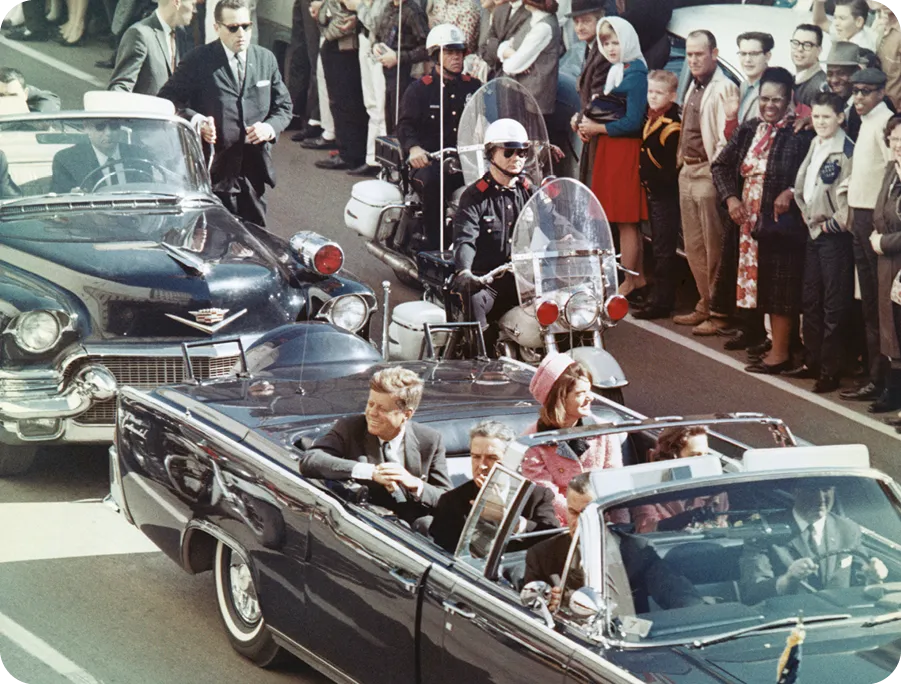
Kennedy's killing was almost immediately folded into a narrative structure that had already surfaced in popular culture as well as politics, a mode of storytelling that treated public events as the expressions of secret plots. Richard Condon's Cold War thriller The Manchurian Candidate (published in 1959 and adapted by Hollywood in 1962) and Thomas Pynchon's shaggy-dog experimental whodunit “V.” are among the best-known pre-assassination examples of this paranoid style in American fiction. [...]
The Warren Commission Report emphatically concluded that Oswald was the sole shooter and the only party responsible for Kennedy's killing. Yet the report did anything but close the case. Through the years that followed, the commission was subjected to a steady stream of revisionism and rebuttal, carried out first by journalists and politicians and later, perhaps more decisively, by novelists and filmmakers. [...]
The disasters of Vietnam and Watergate, along with revelations about the covert activities of the C.I.A. and F.B.I., fed a distrust of the state that would fester on the left and the right. The assassination was seen from both sides as the central event in the secret history of our times, a loose thread that, when pulled, would unravel a skein of sinister plots involving intelligence agencies, the Mafia, Howard Hughes, J. Edgar Hoover, Lyndon B. Johnson and various clandestine organizations and shadowy actors. [...]
Now everything was an inside job. The Kennedy assassination would continue to be a source of fascination in its own right – it anchors James Ellroy's synoptic Underworld U.S.A. trilogy and figures as a plot point in numerous fictions about espionage and organized crime – and it would also become a template, a model for explaining everything. [...]
Elaborate, preposterous alternative scenarios – involving false flags, black ops, hacked voting machines and Deep State machinations – proliferate on social media where they become the basis for algorithmically fueled pseudo-research.
The Warren Commission Report emphatically concluded that Oswald was the sole shooter and the only party responsible for Kennedy's killing. Yet the report did anything but close the case. Through the years that followed, the commission was subjected to a steady stream of revisionism and rebuttal, carried out first by journalists and politicians and later, perhaps more decisively, by novelists and filmmakers. [...]
The disasters of Vietnam and Watergate, along with revelations about the covert activities of the C.I.A. and F.B.I., fed a distrust of the state that would fester on the left and the right. The assassination was seen from both sides as the central event in the secret history of our times, a loose thread that, when pulled, would unravel a skein of sinister plots involving intelligence agencies, the Mafia, Howard Hughes, J. Edgar Hoover, Lyndon B. Johnson and various clandestine organizations and shadowy actors. [...]
Now everything was an inside job. The Kennedy assassination would continue to be a source of fascination in its own right – it anchors James Ellroy's synoptic Underworld U.S.A. trilogy and figures as a plot point in numerous fictions about espionage and organized crime – and it would also become a template, a model for explaining everything. [...]
Elaborate, preposterous alternative scenarios – involving false flags, black ops, hacked voting machines and Deep State machinations – proliferate on social media where they become the basis for algorithmically fueled pseudo-research.
Ressource affichée de l'autre côté.
Faites défiler pour voir la suite.
Faites défiler pour voir la suite.
➜ La traduction de « penser »
think : traduction la plus générale, pour parler d'une activité mentale ou d'une opinion
plan/intend : quand on parle d'un projet ou une intention
consider/reflect on : implique une réflexion plus profonde
believe/mean : exprime une croyance ou une supposition
think : traduction la plus générale, pour parler d'une activité mentale ou d'une opinion
plan/intend : quand on parle d'un projet ou une intention
consider/reflect on : implique une réflexion plus profonde
believe/mean : exprime une croyance ou une supposition
Ressource affichée de l'autre côté.
Faites défiler pour voir la suite.
Faites défiler pour voir la suite.
Questions
You are in charge of one document.
1
Explain what event or issue the document refers to, and why it has generated questions or doubts.
2
Identify two factors that may have contributed to the spread of this narrative.
3
Explain why this type of narrative can feel convincing, despite the evidence.
Let's talk this out!
4
Present your document to the other groups. Explain what makes these narratives appealing, and why they are difficult to challenge.
5
Out of the four conspiracy theories, which do you consider most believable? Why?
6
In your opinion, will it be harder or easier to debunk conspiracy theories in the future with the rise of AI?
Ressource affichée de l'autre côté.
Faites défiler pour voir la suite.
Faites défiler pour voir la suite.
In small groups, take
turns giving a word from
your document. Each
word must be connected
to the previous one.
Explain the connection
as you go.
Ressource affichée de l'autre côté.
Faites défiler pour voir la suite.
Faites défiler pour voir la suite.
The truth is out there!
As members of a truth diggers group, your mission is to create a checklist showing how conspiracy-style narratives are built and why they can be persuasive. Your checklist should include: examples, typical features, a cognitive or emotional mechanism for each, and a warning sign for readers.
As members of a truth diggers group, your mission is to create a checklist showing how conspiracy-style narratives are built and why they can be persuasive. Your checklist should include: examples, typical features, a cognitive or emotional mechanism for each, and a warning sign for readers.
Une erreur sur la page ? Une idée à proposer ?
Nos manuels sont collaboratifs, n'hésitez pas à nous en faire part.
j'ai une idée !
Oups, une coquille