Vue papier

Découvrez la vue papier en cliquant ici
Unit 9
Spotlight
Debunking with A.I.
Ressource affichée de l'autre côté.
Faites défiler pour voir la suite.
Faites défiler pour voir la suite.
angt-unit9-spotlight.mp3

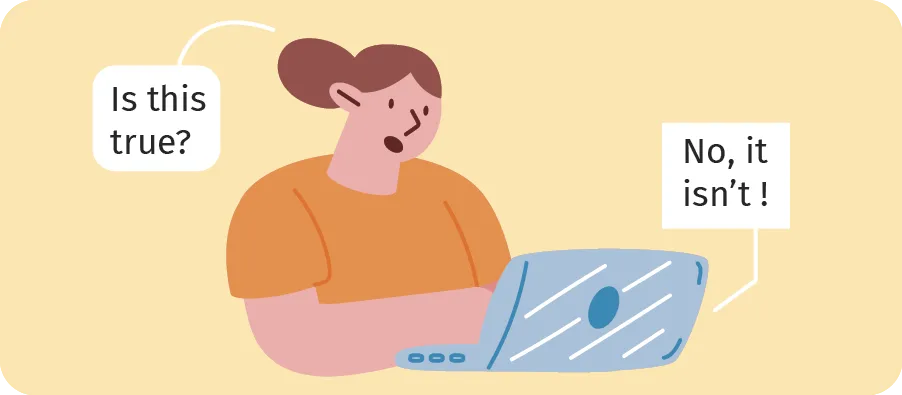
Shortly after generative artificial intelligence hit the mainstream, researchers warned that chatbots would create a dire problem: As disinformation became easier to create, conspiracy theories would spread rampantly.
Now, researchers wonder if chatbots might also offer a solution.
DebunkBot, an A.I. chatbot designed by researchers to “very effectively persuade” users to stop believing unfounded conspiracy theories, made significant and long-lasting progress at changing people's convictions, according to a study published on Thursday in the journal Science.
Indeed, false theories are believed by up to half of the American public and can have damaging consequences, like discouraging vaccinations or fueling discrimination.
The new findings challenge the widely held belief that facts and logic cannot combat conspiracy theories. The DebunkBot, built on the technology that underlies ChatGPT, may offer a practical way to channel facts.
“The work does overturn a lot of how we thought about conspiracies,” said Gordon Pennycook, a psychology professor at Cornell University and author of the study.
Until now, conventional wisdom held that once someone fell down the conspiratorial rabbit hole, no amount of arguing or explaining would pull that person out.
The theory was that people adopt conspiracy theories to sate an underlying need to explain and control their environment, said Thomas Costello, another author of the study and assistant professor of psychology at American University.
But Dr. Costello and his colleagues wondered whether there might be another explanation: What if debunking attempts just haven't been personalized enough?
Since conspiracy theories vary so much from person to person – and each person may cite different pieces of evidence to support one's ideas – perhaps a one-size-fits-all debunking script isn't the best strategy.
A chatbot that can counter each person's conspiratorial claim of choice with troves of information might be much more effective, the researchers thought.
Now, researchers wonder if chatbots might also offer a solution.
DebunkBot, an A.I. chatbot designed by researchers to “very effectively persuade” users to stop believing unfounded conspiracy theories, made significant and long-lasting progress at changing people's convictions, according to a study published on Thursday in the journal Science.
Indeed, false theories are believed by up to half of the American public and can have damaging consequences, like discouraging vaccinations or fueling discrimination.
The new findings challenge the widely held belief that facts and logic cannot combat conspiracy theories. The DebunkBot, built on the technology that underlies ChatGPT, may offer a practical way to channel facts.
“The work does overturn a lot of how we thought about conspiracies,” said Gordon Pennycook, a psychology professor at Cornell University and author of the study.
Until now, conventional wisdom held that once someone fell down the conspiratorial rabbit hole, no amount of arguing or explaining would pull that person out.
The theory was that people adopt conspiracy theories to sate an underlying need to explain and control their environment, said Thomas Costello, another author of the study and assistant professor of psychology at American University.
But Dr. Costello and his colleagues wondered whether there might be another explanation: What if debunking attempts just haven't been personalized enough?
Since conspiracy theories vary so much from person to person – and each person may cite different pieces of evidence to support one's ideas – perhaps a one-size-fits-all debunking script isn't the best strategy.
A chatbot that can counter each person's conspiratorial claim of choice with troves of information might be much more effective, the researchers thought.
Ressource affichée de l'autre côté.
Faites défiler pour voir la suite.
Faites défiler pour voir la suite.
PATH A
B1
1-A
What is DebunkBot and what is its main goal?
2-A
Explain in your own words how DebunkBot
works.
3-A
What results did the researchers observe?
Ressource affichée de l'autre côté.
Faites défiler pour voir la suite.
Faites défiler pour voir la suite.
PATH B
B2
1-B
How does DebunkBot challenge previous
ideas about conspiracy theories?
2-B
Why might it be more effective than
traditional fact-checking?
3-B
What limitations to this technology does
the text suggest?
Ressource affichée de l'autre côté.
Faites défiler pour voir la suite.
Faites défiler pour voir la suite.
Let's talk this out!
4
Share your findings and sum up how DebunkBot changes the way we think about fighting conspiracy theories.
5
In your opinion, should A.I. tools like DebunkBot be more widely used to counter misinformation?
Ressource affichée de l'autre côté.
Faites défiler pour voir la suite.
Faites défiler pour voir la suite.
Pitch your ideas for a debunking tool.
You are part of a research team at Caltech developing a tool to help people resist conspiracy theories online. Pitch your tool to a panel of experts to convince them to invest in your project. Explain how it will work and why it will be effective. Be ready to answer questions about possible challenges!
You are part of a research team at Caltech developing a tool to help people resist conspiracy theories online. Pitch your tool to a panel of experts to convince them to invest in your project. Explain how it will work and why it will be effective. Be ready to answer questions about possible challenges!
Une erreur sur la page ? Une idée à proposer ?
Nos manuels sont collaboratifs, n'hésitez pas à nous en faire part.
j'ai une idée !
Oups, une coquille