Vue papier
Découvrez la vue papier en cliquant ici
Unit 9
Book Club
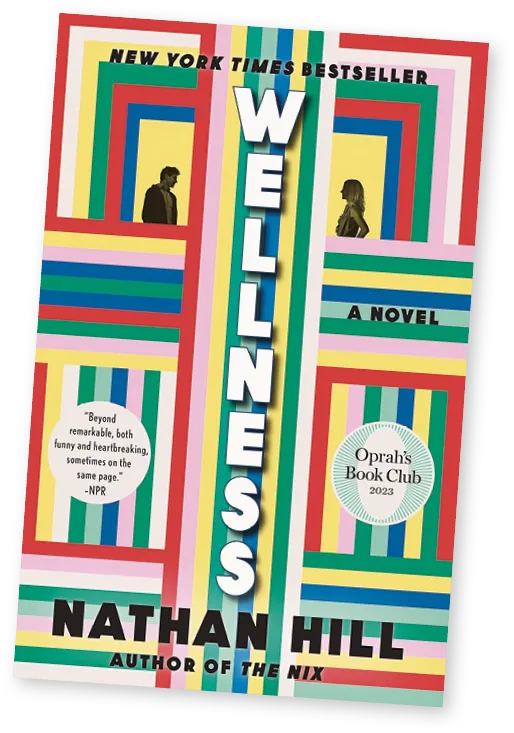
Wellness
Ressource affichée de l'autre côté.
Faites défiler pour voir la suite.
Faites défiler pour voir la suite.
Wellness focuses on the marriage of Jack and Elizabeth, who come of age in the
bohemian art scene of mid-1990s Chicago. Two decades later, as they approach
middle age, they struggle with the gap between their ideals and reality.
Alongside their story, the novel follows Jack's father, Lawrence Baker, whose
late-in-life entry into the digital world reveals the darker side of online culture.
Ressource affichée de l'autre côté.
Faites défiler pour voir la suite.
Faites défiler pour voir la suite.
Texte
Wellness
It is April 2008, and Lawrence Baker has just joined Facebook.
The algorithm is like a waiter, and Lawrence is a diner who stares at the menu but never orders food. That is, not until the day the algorithm asks: Do you know Jack Baker?
And Lawrence sits there staring at that prompt for a full fifteen minutes before finally confirming it – Yes – whereby the algorithm launches a friend request.
This connection with Jack seems to inspire a new enthusiasm for the prompts he had been previously ignoring, and he goes ahead and reaches out to other friends within the network, and he identifies a few interests and hobbies, and he writes his first tentative updates and posts a photo.
He chooses a profile picture, and his friends seem to love it. He posts about the Chiefs game, and his friends seem to love it. Even just his comments about the weather and the wind generate a flurry of positive response.
It is the most contact he's had with the wider world in years.
Each of Lawrence's actions and combinations of actions, each post and like, each comment and message, each bit of logged data is but one dimension the algorithm uses to compare Lawrence with Facebook's other billion accounts in an effort to figure out what, exactly, he is.
Lawrence, of course, has no idea this is happening. But he does notice the new and troubling updates now populating his feed. These mostly have to do with people getting sick. Often, children.
Lawrence reads and clicks and comments on all of them, often telling whoever posted the story or update or photo or video that it caused him to choke up a little bit and that he's sending his warmest wishes.
And the algorithm translates all of this activity into its relevant abstracted mathematical values and compares them many-dimensionally to all other account data to find that Lawrence seems to match up pretty closely to other American Facebook users for whom the specific subject of “Illness” and the more general subject of “Contamination” prove to be highly salient. Which is why Lawrence keeps seeing these stories and updates and videos about sick children, so many sick children that it seems like there's some kind of epidemic going on, that the number of children who are dangerously, dramatically sick is higher now than at any other point he can ever remember. He does not consider the possibility that the number of sick children in the world is roughly constant and that the variable here is how many of these sick children he's exposed to via Facebook.
These new connections are added to his profile data, whereby the Pattern Recognition algorithm determines, based on various affinity matrices and edge strengths and eigenvalues and principal component analyses, that Lawrence clusters pretty seamlessly with members of certain wellness-related Facebook groups – among them, the Health Freedom Network and the Awakened Patient Project and the Big Pharma Report and ScienceAlert and CancerTruth and the Truth Unleashed and the Truth Movement and What Your Doctor Isn't Telling You and so forth – all of which the algorithm recommends to him, and all of which, as it predicted, he faithfully joins.
The ideas and theories and facts that Lawrence encounters in these particular Facebook communities are, to put it mildly, distressing. They are so distressing and troubling and occasionally downright disturbing that he decides he really needs to verify them independently.
[He] clicks over to Google and slowly types into the search bar all of the pressing questions:
Do cell phone towers really cause cancer?
Are jet contrails really poisonous?
Is the fluoride the government puts into the drinking water actually making the population so foggy-headed and dumb and passive that we don't notice all of these obvious plots and lies?
Of course, Lawrence does not consider the basic flaw in his search logic: namely, that websites about whether fluoride is poisonous are almost always made by people who believe that, yes, it definitely is.
Here then begins a phase where Lawrence returns to those questionable new Facebook groups and comments on their pages about how he was initially dubious about their claims but then “I did my own research,” he says, “to make up my own mind,” he says, whereby he found, much to his shock and dismay, that the claims “checked out,” and it's at this point in each of these various groups where the acceptance and support and love from the group is cast upon Lawrence like a warm summer dawn.
The algorithm is like a waiter, and Lawrence is a diner who stares at the menu but never orders food. That is, not until the day the algorithm asks: Do you know Jack Baker?
And Lawrence sits there staring at that prompt for a full fifteen minutes before finally confirming it – Yes – whereby the algorithm launches a friend request.
This connection with Jack seems to inspire a new enthusiasm for the prompts he had been previously ignoring, and he goes ahead and reaches out to other friends within the network, and he identifies a few interests and hobbies, and he writes his first tentative updates and posts a photo.
He chooses a profile picture, and his friends seem to love it. He posts about the Chiefs game, and his friends seem to love it. Even just his comments about the weather and the wind generate a flurry of positive response.
It is the most contact he's had with the wider world in years.
Each of Lawrence's actions and combinations of actions, each post and like, each comment and message, each bit of logged data is but one dimension the algorithm uses to compare Lawrence with Facebook's other billion accounts in an effort to figure out what, exactly, he is.
Lawrence, of course, has no idea this is happening. But he does notice the new and troubling updates now populating his feed. These mostly have to do with people getting sick. Often, children.
Lawrence reads and clicks and comments on all of them, often telling whoever posted the story or update or photo or video that it caused him to choke up a little bit and that he's sending his warmest wishes.
And the algorithm translates all of this activity into its relevant abstracted mathematical values and compares them many-dimensionally to all other account data to find that Lawrence seems to match up pretty closely to other American Facebook users for whom the specific subject of “Illness” and the more general subject of “Contamination” prove to be highly salient. Which is why Lawrence keeps seeing these stories and updates and videos about sick children, so many sick children that it seems like there's some kind of epidemic going on, that the number of children who are dangerously, dramatically sick is higher now than at any other point he can ever remember. He does not consider the possibility that the number of sick children in the world is roughly constant and that the variable here is how many of these sick children he's exposed to via Facebook.
These new connections are added to his profile data, whereby the Pattern Recognition algorithm determines, based on various affinity matrices and edge strengths and eigenvalues and principal component analyses, that Lawrence clusters pretty seamlessly with members of certain wellness-related Facebook groups – among them, the Health Freedom Network and the Awakened Patient Project and the Big Pharma Report and ScienceAlert and CancerTruth and the Truth Unleashed and the Truth Movement and What Your Doctor Isn't Telling You and so forth – all of which the algorithm recommends to him, and all of which, as it predicted, he faithfully joins.
The ideas and theories and facts that Lawrence encounters in these particular Facebook communities are, to put it mildly, distressing. They are so distressing and troubling and occasionally downright disturbing that he decides he really needs to verify them independently.
[He] clicks over to Google and slowly types into the search bar all of the pressing questions:
Do cell phone towers really cause cancer?
Are jet contrails really poisonous?
Is the fluoride the government puts into the drinking water actually making the population so foggy-headed and dumb and passive that we don't notice all of these obvious plots and lies?
Of course, Lawrence does not consider the basic flaw in his search logic: namely, that websites about whether fluoride is poisonous are almost always made by people who believe that, yes, it definitely is.
Here then begins a phase where Lawrence returns to those questionable new Facebook groups and comments on their pages about how he was initially dubious about their claims but then “I did my own research,” he says, “to make up my own mind,” he says, whereby he found, much to his shock and dismay, that the claims “checked out,” and it's at this point in each of these various groups where the acceptance and support and love from the group is cast upon Lawrence like a warm summer dawn.
Ressource affichée de l'autre côté.
Faites défiler pour voir la suite.
Faites défiler pour voir la suite.
a) How does
Lawrence's behaviour
on Facebook change
after connecting
with Jack?
Ressource affichée de l'autre côté.
Faites défiler pour voir la suite.
Faites défiler pour voir la suite.
b) How do Lawrence's
actions contribute to
the platform's goals?
Ressource affichée de l'autre côté.
Faites défiler pour voir la suite.
Faites défiler pour voir la suite.
c) What kind of posts
does he respond to?
Ressource affichée de l'autre côté.
Faites défiler pour voir la suite.
Faites défiler pour voir la suite.
d) Why does he see so
many of these posts?
Ressource affichée de l'autre côté.
Faites défiler pour voir la suite.
Faites défiler pour voir la suite.
e) What role do
wellness-related
groups play in
shaping Lawrence's
online identity?
Ressource affichée de l'autre côté.
Faites défiler pour voir la suite.
Faites défiler pour voir la suite.
f) How does Lawrence
“verify” the ideas
he encounters in
these groups?
Ressource affichée de l'autre côté.
Faites défiler pour voir la suite.
Faites défiler pour voir la suite.
g) Why is his logic
flawed?
Ressource affichée de l'autre côté.
Faites défiler pour voir la suite.
Faites défiler pour voir la suite.
h) How do the online
groups react to his
conclusions?
Ressource affichée de l'autre côté.
Faites défiler pour voir la suite.
Faites défiler pour voir la suite.
Nathan Hill is an American novelist and former newspaper reporter.
After working as a journalist in Iowa, he moved to New York to enter
the literary world. He faced many rejections for his short stories and
he spent ten years writing his first novel, The Nix, which was published
in 2016 and won major awards. His second novel, Wellness, published
in 2023, received wide attention and was chosen for Oprah's Book
Club. Hill continues to write both fiction and journalistic articles.


Ressource affichée de l'autre côté.
Faites défiler pour voir la suite.
Faites défiler pour voir la suite.
“Make up your own mind!”
Jack is becoming increasingly worried about his father's readiness to believe what he reads online. Imagine the email he would write to his father. Explain what “clickbait” is and how to fact-check properly.
Jack is becoming increasingly worried about his father's readiness to believe what he reads online. Imagine the email he would write to his father. Explain what “clickbait” is and how to fact-check properly.
Une erreur sur la page ? Une idée à proposer ?
Nos manuels sont collaboratifs, n'hésitez pas à nous en faire part.
j'ai une idée !
Oups, une coquille