Vue papier
Découvrez la vue papier en cliquant ici
Unit 10
Book Club
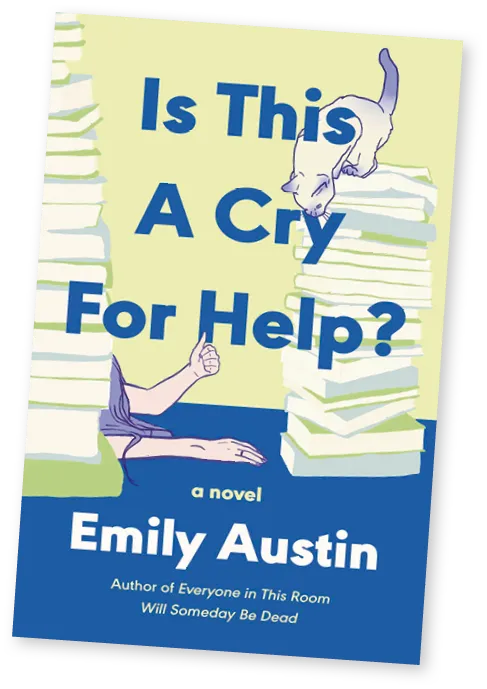
Is This a Cry for Help?
Ressource affichée de l'autre côté.
Faites défiler pour voir la suite.
Faites défiler pour voir la suite.
Is This a Cry for Help? tells the story of Darcy, a librarian who returns to work
after a mental breakdown, only to find herself at the center of a growing
battle over book bans. Her life with her wife Joy is loving and quietly joyful:
overflowing bookshelves, two cats, and a shared belief in the power of stories.
When she comes back to the library, the community is deeply divided.
Parents and activists are challenging books and turning the library into
a political battleground, leading to a tense public meeting.

Ressource affichée de l'autre côté.
Faites défiler pour voir la suite.
Faites défiler pour voir la suite.
Texte
Is This a Cry for Help?
“I'd like to call this meeting to order,” the chairperson says into the microphone.
Joy offers me a piece of gum while the board members do roll call and approve the agenda. She and I are sitting near the back of the room. I'm off the clock. We're both here as community members. We're in a municipal building in a sizable hall. There's a platform at the front of the room where the board members are sitting on wooden chairs. At the center of the hall, there's a large screen that projects the words COMMUNITY CONSULTATION. [...]
“This consultation was arranged in response to an influx of community concerns relating to our collection development and program planning policies. Rhonda Wheeler, library CEO, is here to briefly present those policies to us. Following that, we'll open the floor for public comments.”
Rhonda stands up. [...]
She addresses the room. “Hello everyone. Thank you you for your presence today.” [...]
“We have criteria we use to evaluate the material in our collection. We consider community demand and relevance to our community's needs. We also consider quality, including literary merit, accuracy, authority, and currency. In addition, we consider availability and, of course, budget. More detail about our criteria can be found on the library website.”
Rhonda speaks, as if she were pledging allegiance, “We believe in equitable access to information. We believe in providing inclusive, welcoming, and accessible services that embrace diversity. We defend intellectual freedom. We are committed to community development, lifelong learning, and literacy.” She pauses, then says, “Thank you.”
As she turns around to sit back down, Robert, a member of the board, stands up. [...]
“Please come up and share your thoughts and opinions. They'll be put on record and used to support our final decision. We have the next forty minutes. Try to share your thoughts as succinctly as possible to save time for others. Thanks all.” [...]
“Hello, everyone. My name is Declan Turner. I'm a local reporter, as well as a concerned father and citizen.”
He continues, “I hope I speak for the majority of the people here today when I say we need to protect our kids from sexual deviants. At this time, I firmly believe opportunists and predators are drawn to our library because of the books and events we promote.” [...]
A line formed behind Declan while he was speaking. A woman in a blazer takes the mic. “Hi. I'm Paula West. I share the concerns raised by Mr. Turner. Also, I'd like to point out that a lot of what Ms. Wheeler said earlier was peppered with buzzwords like “diversity” and “inclusion.” [...] Who are we being inclusive of exactly? I'm a taxpayer and a member of this community. I don't feel the library is being inclusive of me, my family, or of anyone in our community who has traditional values. I believe we need to have better moral standards for our library, and that one of our objectives should be to protect the innocence of our children. I urge the board to reconsider the books and programs our library offers and to uphold the traditional, moral principles of our community.”
I look at the books projected on the screen. Almost all of them are about LGBTQ+ people or people of color. [...]
A woman in purple overalls is at the microphone now. She has a baby strapped to her chest. “Hi. My name is Anita Maple. I'm a parent. I don't understand why a small group of people think they should be who determines what my children, or any kids in our community, can and cannot read. I want my kids, and our whole community, to have access to books that depict a diverse array of people. [...] This is a public library. My next-door neighbors are Sikh. I'm Jewish. The library is full of Christian books. I'm not asking us to ban books about Easter regardless of having no interest in sharing those with my kids. This is a community space. No one should be banning books. Thank you.” [...]
Joy is standing at the mic now. “Hi. My name's Joy Carpenter. I've lived in the area for about six years. [...] I didn't read a book with a lesbian in it until I was twenty-five years old. Not seeing myself in books impacted how I understood myself and how I connected with others. I think I might have realized I was gay sooner if I'd been exposed to more stories with people like me in them. I'm grateful that there are books for kids today that feature the people and families they see mirrored in their own lives. We need to see ourselves in stories. We need to see people who aren't like us too. Diverse books that feature characters of different races, cultures, gender, sexual orientation, ability, religion, and family structures help us develop understanding and empathy. What is the point of reading? What is the point of the library? We want to learn and connect with other people. Our library needs to be a community space that welcomes and values everyone. Please don't remove any of these books from our shelves. Thank you.”
Joy offers me a piece of gum while the board members do roll call and approve the agenda. She and I are sitting near the back of the room. I'm off the clock. We're both here as community members. We're in a municipal building in a sizable hall. There's a platform at the front of the room where the board members are sitting on wooden chairs. At the center of the hall, there's a large screen that projects the words COMMUNITY CONSULTATION. [...]
“This consultation was arranged in response to an influx of community concerns relating to our collection development and program planning policies. Rhonda Wheeler, library CEO, is here to briefly present those policies to us. Following that, we'll open the floor for public comments.”
Rhonda stands up. [...]
She addresses the room. “Hello everyone. Thank you you for your presence today.” [...]
“We have criteria we use to evaluate the material in our collection. We consider community demand and relevance to our community's needs. We also consider quality, including literary merit, accuracy, authority, and currency. In addition, we consider availability and, of course, budget. More detail about our criteria can be found on the library website.”
Rhonda speaks, as if she were pledging allegiance, “We believe in equitable access to information. We believe in providing inclusive, welcoming, and accessible services that embrace diversity. We defend intellectual freedom. We are committed to community development, lifelong learning, and literacy.” She pauses, then says, “Thank you.”
As she turns around to sit back down, Robert, a member of the board, stands up. [...]
“Please come up and share your thoughts and opinions. They'll be put on record and used to support our final decision. We have the next forty minutes. Try to share your thoughts as succinctly as possible to save time for others. Thanks all.” [...]
“Hello, everyone. My name is Declan Turner. I'm a local reporter, as well as a concerned father and citizen.”
He continues, “I hope I speak for the majority of the people here today when I say we need to protect our kids from sexual deviants. At this time, I firmly believe opportunists and predators are drawn to our library because of the books and events we promote.” [...]
A line formed behind Declan while he was speaking. A woman in a blazer takes the mic. “Hi. I'm Paula West. I share the concerns raised by Mr. Turner. Also, I'd like to point out that a lot of what Ms. Wheeler said earlier was peppered with buzzwords like “diversity” and “inclusion.” [...] Who are we being inclusive of exactly? I'm a taxpayer and a member of this community. I don't feel the library is being inclusive of me, my family, or of anyone in our community who has traditional values. I believe we need to have better moral standards for our library, and that one of our objectives should be to protect the innocence of our children. I urge the board to reconsider the books and programs our library offers and to uphold the traditional, moral principles of our community.”
I look at the books projected on the screen. Almost all of them are about LGBTQ+ people or people of color. [...]
A woman in purple overalls is at the microphone now. She has a baby strapped to her chest. “Hi. My name is Anita Maple. I'm a parent. I don't understand why a small group of people think they should be who determines what my children, or any kids in our community, can and cannot read. I want my kids, and our whole community, to have access to books that depict a diverse array of people. [...] This is a public library. My next-door neighbors are Sikh. I'm Jewish. The library is full of Christian books. I'm not asking us to ban books about Easter regardless of having no interest in sharing those with my kids. This is a community space. No one should be banning books. Thank you.” [...]
Joy is standing at the mic now. “Hi. My name's Joy Carpenter. I've lived in the area for about six years. [...] I didn't read a book with a lesbian in it until I was twenty-five years old. Not seeing myself in books impacted how I understood myself and how I connected with others. I think I might have realized I was gay sooner if I'd been exposed to more stories with people like me in them. I'm grateful that there are books for kids today that feature the people and families they see mirrored in their own lives. We need to see ourselves in stories. We need to see people who aren't like us too. Diverse books that feature characters of different races, cultures, gender, sexual orientation, ability, religion, and family structures help us develop understanding and empathy. What is the point of reading? What is the point of the library? We want to learn and connect with other people. Our library needs to be a community space that welcomes and values everyone. Please don't remove any of these books from our shelves. Thank you.”
Ressource affichée de l'autre côté.
Faites défiler pour voir la suite.
Faites défiler pour voir la suite.
a) What kind
of public event is
being described?
Ressource affichée de l'autre côté.
Faites défiler pour voir la suite.
Faites défiler pour voir la suite.
b) Why is Rhonda's
role important?
Ressource affichée de l'autre côté.
Faites défiler pour voir la suite.
Faites défiler pour voir la suite.
c) What does Rhonda
explain about the
library's role and
values?
Ressource affichée de l'autre côté.
Faites défiler pour voir la suite.
Faites défiler pour voir la suite.
d) What accusations
does Declan Turner
make against
the library?
What emotions does his speech appeal to?
What emotions does his speech appeal to?
Ressource affichée de l'autre côté.
Faites défiler pour voir la suite.
Faites défiler pour voir la suite.
e) Why does Paula
West challenge the
ideas of diversity
and inclusion?
Ressource affichée de l'autre côté.
Faites défiler pour voir la suite.
Faites défiler pour voir la suite.
f) What argument
does Anita Maple
make?
Ressource affichée de l'autre côté.
Faites défiler pour voir la suite.
Faites défiler pour voir la suite.
g) Why is Joy
Carpenter's testimony
more personal than
the others?
Ressource affichée de l'autre côté.
Faites défiler pour voir la suite.
Faites défiler pour voir la suite.
h) According to Joy,
what is the purpose
of reading?
Ressource affichée de l'autre côté.
Faites défiler pour voir la suite.
Faites défiler pour voir la suite.
i) How do these
opinions reflect
divisions within
American society?
Ressource affichée de l'autre côté.
Faites défiler pour voir la suite.
Faites défiler pour voir la suite.
Emily Austin is a Canadian author whose work explores themes of
mental health, neurodivergence, and queerness, with emotional
honesty and humor. After studying English literature and library
science, she published her debut novel, Everyone in This Room
Will Someday Be Dead (2021), which received widespread praise
for its portrayal of anxiety and life's absurdities.
Ressource affichée de l'autre côté.
Faites défiler pour voir la suite.
Faites défiler pour voir la suite.
Making headlines
You are a reporter for the school newspaper, covering the consultation meeting. Write about what happened and present the arguments shared by community members without taking sides. Imagine the outcome and decision made by the board after the meeting.
You are a reporter for the school newspaper, covering the consultation meeting. Write about what happened and present the arguments shared by community members without taking sides. Imagine the outcome and decision made by the board after the meeting.
Une erreur sur la page ? Une idée à proposer ?
Nos manuels sont collaboratifs, n'hésitez pas à nous en faire part.
j'ai une idée !
Oups, une coquille