Vue papier
Découvrez la vue papier en cliquant ici
Unit 15
Activity 1
Understanding the divide
Ressource affichée de l'autre côté.
Faites défiler pour voir la suite.
Faites défiler pour voir la suite.
1
The roots of the conflict
angt-unit15-activity1-doc1.mp3
The Troubles [was a] violent sectarian conflict from about 1968 to 1998 in Northern Ireland between the overwhelmingly Protestant unionists (loyalists), who desired the province to remain part of the United Kingdom, and the overwhelmingly Roman Catholic nationalists (republicans), who wanted Northern Ireland to become part of the republic of Ireland. [...]
In 1920, during the Irish War of Independence (1919–21), the British Parliament, responding largely to the wishes of Ulster loyalists, enacted the Government of Ireland Act, which divided the island into two self-governing areas with devolved Home Rule-like powers. [...]
Thus, in 1922 Northern Ireland began functioning as a self-governing region of the United Kingdom. Two-thirds of its population (about one million people) was Protestant and about one-third (roughly 500,000 people) was Catholic. The divide between Catholics and Protestants in Northern Ireland had little to do with theological differences but instead was grounded in culture and politics. [...]
As the 1970s progressed, rioting became more common in Belfast and Derry, bombings of public places (by both loyalists and republicans) increased, and both sides of the conflict perpetrated violent, deadly atrocities. [...]
On January 30, 1972, the conflict reached a new level of intensity when British paratroopers fired on Catholic civil rights demonstrators in Londonderry, killing 13 and injuring 14 others (one of whom later died). The incident [...] became known as “Bloody Sunday.”
In 1920, during the Irish War of Independence (1919–21), the British Parliament, responding largely to the wishes of Ulster loyalists, enacted the Government of Ireland Act, which divided the island into two self-governing areas with devolved Home Rule-like powers. [...]
Thus, in 1922 Northern Ireland began functioning as a self-governing region of the United Kingdom. Two-thirds of its population (about one million people) was Protestant and about one-third (roughly 500,000 people) was Catholic. The divide between Catholics and Protestants in Northern Ireland had little to do with theological differences but instead was grounded in culture and politics. [...]
As the 1970s progressed, rioting became more common in Belfast and Derry, bombings of public places (by both loyalists and republicans) increased, and both sides of the conflict perpetrated violent, deadly atrocities. [...]
On January 30, 1972, the conflict reached a new level of intensity when British paratroopers fired on Catholic civil rights demonstrators in Londonderry, killing 13 and injuring 14 others (one of whom later died). The incident [...] became known as “Bloody Sunday.”
Ressource affichée de l'autre côté.
Faites défiler pour voir la suite.
Faites défiler pour voir la suite.
2
A step towards peace

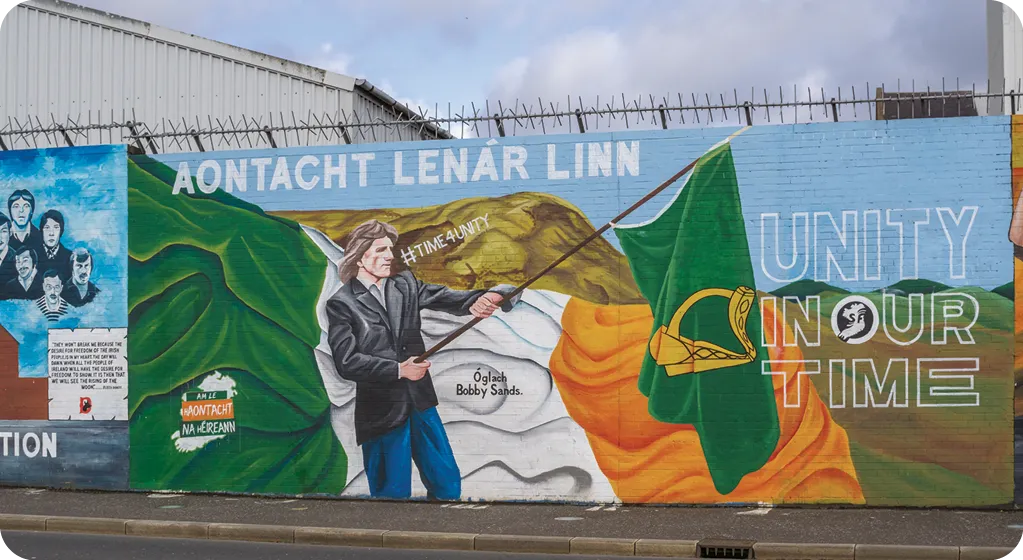
A mural on Falls Road representing Bobby Sands and calling for unity, 2022.
Vidéo associée
Ressource affichée de l'autre côté.
Faites défiler pour voir la suite.
Faites défiler pour voir la suite.
3
Walls that still divide

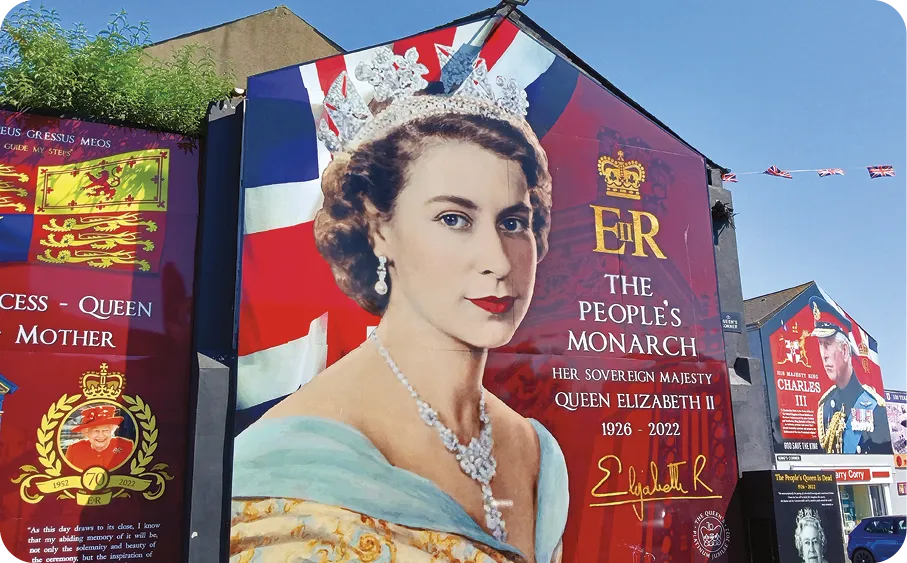
Mural on Shankill road honouring Queen Elizabeth II after her death, 2023.
Vidéo associée
From 0:22 to 2:42Ressource affichée de l'autre côté.
Faites défiler pour voir la suite.
Faites défiler pour voir la suite.
Questions
1
Read the text. What were the main causes of the Troubles?
2
Watch the videos. Identify the main points of the Good Friday Agreement. How has life in Northern Ireland changed since it was signed, and what challenges remain?
3
Which mural represents the republicans and which one represents the loyalists? What do they show about Ireland's history and identity?
Ressource affichée de l'autre côté.
Faites défiler pour voir la suite.
Faites défiler pour voir la suite.
Background check
To what extent is religion at the centre of the Partition of Ireland?Ressource affichée de l'autre côté.
Faites défiler pour voir la suite.
Faites défiler pour voir la suite.
In groups, create a collaborative timeline: Each
student adds one date mentioned in the documents
above and explains what happened then.
Une erreur sur la page ? Une idée à proposer ?
Nos manuels sont collaboratifs, n'hésitez pas à nous en faire part.
j'ai une idée !
Oups, une coquille