Vue papier
Découvrez la vue papier en cliquant ici
Unit 2
Spotlight
Threads of connection
Ressource affichée de l'autre côté.
Faites défiler pour voir la suite.
Faites défiler pour voir la suite.
Tanya Aguiñiga, mending the divide
Tanya Aguiñiga, mending the divide on the NFL
For Tanya Aguiñiga, the wall was never far from view and thus the border was always present. As a child, she crossed over from the brightly colored crafts of Tijuana's markets to the cold, industrial minimalism of San Diego on her way to and from school. As an artist, activist, and designer, Aguiñiga continues to traverse this boundary both physically and through her practice. In so doing, she has become like a loom's shuttle, weaving together either side of a rent land.
Craft & Care, currently on view at the Museum of Arts and Design, features the work that results from a lifetime of creating a tapestry from broken threads. [...]
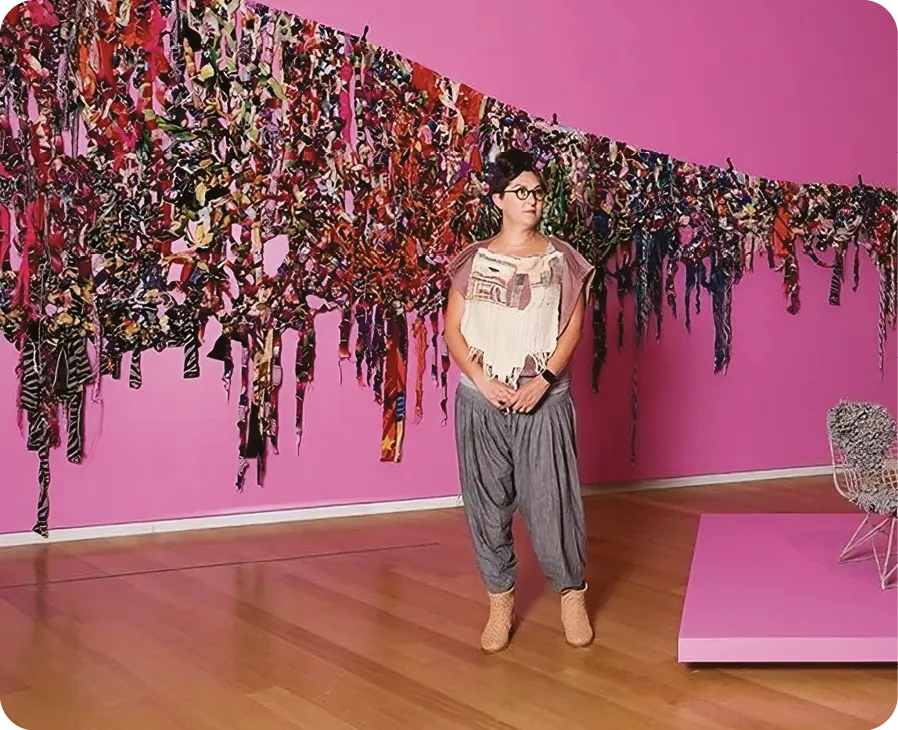
“Border Quipu/Quipu Fronterizo” [...] contains the difficult realities of borders within startlingly vibrant hues. To create this participatory work, Aguiñiga and her team walked from car to car on either side of 18 border checkpoints in California, Arizona, and Texas, inviting passengers to tie a knot in upcycled bikini and dress straps as evidence of their crossing.
The result is a curved row of textiles that descends from the ceiling in soft columns. Using quipu, an ancient Andean form of time keeping, each knot represents an individual experience and each textile the amalgamation of hours and days spent traversing the liminal space that exists at the border crossings between the United States and Mexico.
“Border Quipu/Quipu Fronterizo” [...] contains the difficult realities of borders within startlingly vibrant hues. To create this participatory work, Aguiñiga and her team walked from car to car on either side of 18 border checkpoints in California, Arizona, and Texas, inviting passengers to tie a knot in upcycled bikini and dress straps as evidence of their crossing.
The result is a curved row of textiles that descends from the ceiling in soft columns. Using quipu, an ancient Andean form of time keeping, each knot represents an individual experience and each textile the amalgamation of hours and days spent traversing the liminal space that exists at the border crossings between the United States and Mexico.
Ressource affichée de l'autre côté.
Faites défiler pour voir la suite.
Faites défiler pour voir la suite.
Vidéo associée
Ressource affichée de l'autre côté.
Faites défiler pour voir la suite.
Faites défiler pour voir la suite.
PATH A
B1
1-A
Watch the video. How does Tanya Aguiñiga describe her daily experience crossing the border?
2-A
Look at the photo of the Border Quipu, then read the text. What is the Border Quipu made of? What technique did she use?
3-A
How did the artist involve the community
in the process?
Ressource affichée de l'autre côté.
Faites défiler pour voir la suite.
Faites défiler pour voir la suite.
PATH B
B1+
1-B
Watch the video. How does Tanya Aguiñiga
link her personal experience with her art?
2-B
What motivated Tanya to create the AMBOS
project? What is its purpose?
3-B
Read the text. Find quotes showing the
parallels between textile craft and the
experience of crossing the border.
Ressource affichée de l'autre côté.
Faites défiler pour voir la suite.
Faites défiler pour voir la suite.
Let's talk this out!
4
Share your answers. What message do you think Tanya Aguiñiga is trying to send?
5
How do these artworks challenge the way people usually think about borders and migration?
Ressource affichée de l'autre côté.
Faites défiler pour voir la suite.
Faites défiler pour voir la suite.
Describe a work of art.
Imagine you are an artist living on the U.S.-Mexico border, like Tanya Aguiñiga. Write a short paragraph describing an artwork that represents your personal experience with the border. What materials would you use, and how would they reflect the daily realities of crossing or living near the border? What message and emotion would your artwork convey?
Imagine you are an artist living on the U.S.-Mexico border, like Tanya Aguiñiga. Write a short paragraph describing an artwork that represents your personal experience with the border. What materials would you use, and how would they reflect the daily realities of crossing or living near the border? What message and emotion would your artwork convey?
Une erreur sur la page ? Une idée à proposer ?
Nos manuels sont collaboratifs, n'hésitez pas à nous en faire part.
j'ai une idée !
Oups, une coquille