Unit 6
Tech Exploration
Darkroom stories
Ressource affichée de l'autre côté.
Faites défiler pour voir la suite.
Faites défiler pour voir la suite.
National Gallery of Art
In 1958 Lange accompanied her husband Paul Taylor on a seven-month business trip. Taylor's work consulting for the Agency for International Development took them to countries throughout Asia, including South Korea.
While they were there, Lange photographed with a new 35-mm camera. Unlike the heavy, large-format cameras she had used before, the smaller 35-mm was ideal for travel photography. [...]
While visiting a local school, she photographed a group of excited students in a crowded classroom. Despite the children's joyful commotion, their tattered clothes hint at the economic downturn that followed the Korean War.
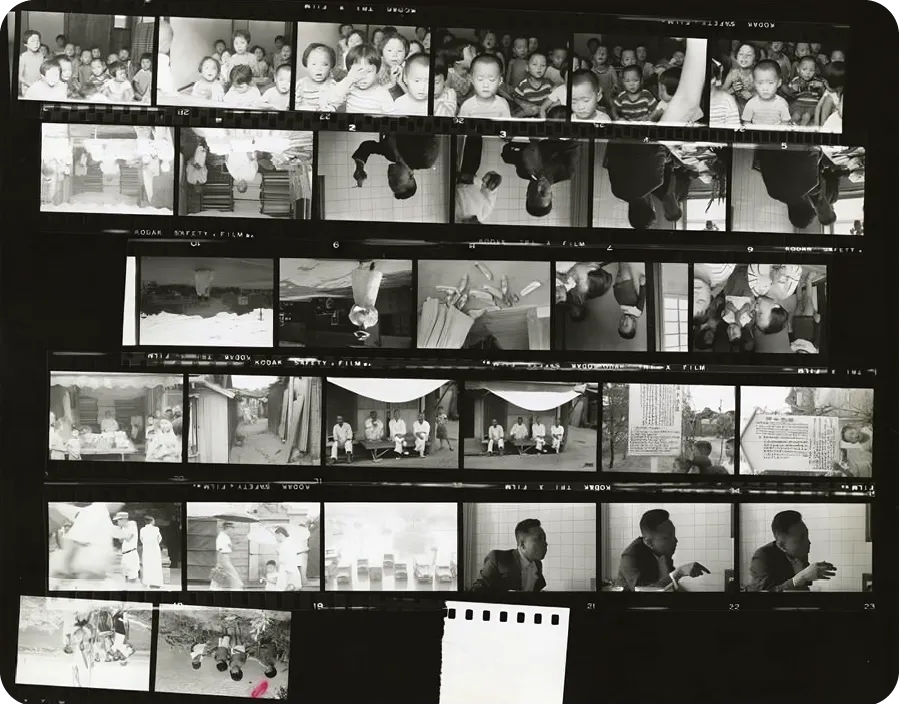
This contact sheet shows Lange's photographs from that classroom. A contact sheet is the positive print of negative images from a roll of film. These sheets offer insight into how a photographer works – and how they choose images to enlarge and develop in the darkroom. [...]
The fourth image from the left is the one that Lange ultimately chose to print. In this picture, one of the boys in the front row faces forward. Some photographers might have dismissed this image as flawed – the boy is blinking after all. But Lange may have seen in his face a moment of peace in the otherwise lively scene. [...]
Lange insulated this boy from the bustle of the classroom by dramatically cropping her photograph. [...]
It seems that the area around the boy's face was darkened. This was likely done not by Lange herself, but by the San Francisco-based printer she worked with while preparing for her 1966 MoMA retrospective, Irwin Welcher. Welcher may have used a darkroom technique called burning to darken a specific area of the print by exposing it to extra light.
While they were there, Lange photographed with a new 35-mm camera. Unlike the heavy, large-format cameras she had used before, the smaller 35-mm was ideal for travel photography. [...]
While visiting a local school, she photographed a group of excited students in a crowded classroom. Despite the children's joyful commotion, their tattered clothes hint at the economic downturn that followed the Korean War.
This contact sheet shows Lange's photographs from that classroom. A contact sheet is the positive print of negative images from a roll of film. These sheets offer insight into how a photographer works – and how they choose images to enlarge and develop in the darkroom. [...]
The fourth image from the left is the one that Lange ultimately chose to print. In this picture, one of the boys in the front row faces forward. Some photographers might have dismissed this image as flawed – the boy is blinking after all. But Lange may have seen in his face a moment of peace in the otherwise lively scene. [...]
Lange insulated this boy from the bustle of the classroom by dramatically cropping her photograph. [...]
It seems that the area around the boy's face was darkened. This was likely done not by Lange herself, but by the San Francisco-based printer she worked with while preparing for her 1966 MoMA retrospective, Irwin Welcher. Welcher may have used a darkroom technique called burning to darken a specific area of the print by exposing it to extra light.
Ressource affichée de l'autre côté.
Faites défiler pour voir la suite.
Faites défiler pour voir la suite.



Vidéo associée
Ressource affichée de l'autre côté.
Faites défiler pour voir la suite.
Faites défiler pour voir la suite.
Communication
1-A
What do contact sheets reveal about a photographer's working process?
2-A
What choices were made to edit the picture of the boy, and why?
3-A
Does an image on its own tell a different story than when it is part of a series?
Ressource affichée de l'autre côté.
Faites défiler pour voir la suite.
Faites défiler pour voir la suite.
Science
1-B
How does the contact sheet help a photographer make technical decisions?
2-B
What darkroom tools or processes were used to enhance the final photo?
3-B
How do photographic tools and choices influence the viewer's interpretation?
Ressource affichée de l'autre côté.
Faites défiler pour voir la suite.
Faites défiler pour voir la suite.
Communication
Curator's choice
Choose one image from the contact sheet (not the one Lange chose), and write a caption explaining why you would have selected it for the final print. Mention how you would crop or edit it using darkroom vocabulary to make it more powerful.
Science
Photographer's process
Record a short “Behind the Image” voiceover script explaining how the final photo on the right was created. Include the technical steps from the shoot to the printing, and explain how these techniques shaped the final message.
Une erreur sur la page ? Une idée à proposer ?
Nos manuels sont collaboratifs, n'hésitez pas à nous en faire part.
j'ai une idée !
Oups, une coquille