
Unit 6
Book Club
Ressource affichée de l'autre côté.
Faites défiler pour voir la suite.
Faites défiler pour voir la suite.
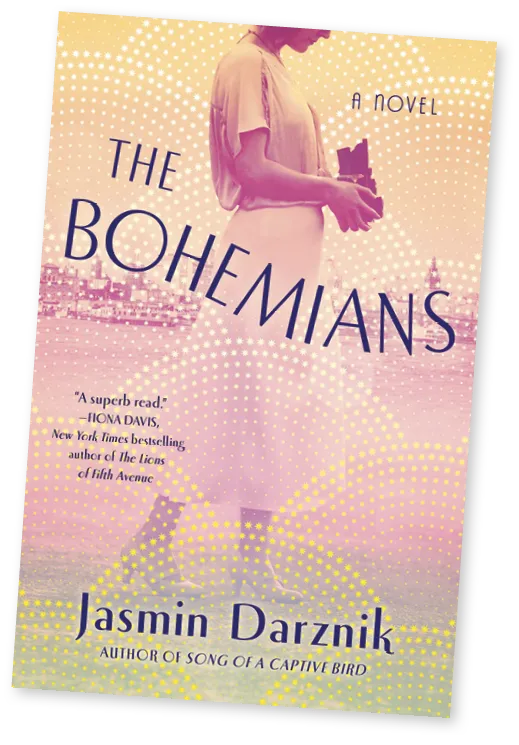
The Bohemians is a historical novel that imagines the early life of
Dorothea Lange, the pioneering American photographer best known for
her iconic portraits of the Great Depression. Set in San Francisco in the
1920s and 1930s, the book explores how Lange found her artistic voice
and overcame personal and societal challenges. Blending fact and fiction,
The Bohemians offers a rich portrait of a young woman determined to make
her mark on the world, and of the stories she chose to tell through her lens.

Ressource affichée de l'autre côté.
Faites défiler pour voir la suite.
Faites défiler pour voir la suite.
Texte
The Bohemians
A portrait is many things: a document, a moment in time, a refuge for memory. But above all, it is the meeting of two people, the seer and the seen.
When I was younger, I wanted to walk in the world as if I were invisible, but slowly I came to realize you couldn't really see people if you're bent on hiding all the time. You had to show people who you were if you hoped they'd show you something of themselves. You had to let yourself be seen. If you gave a person that as well as your deepest attention and then waited, sometimes you could capture their secret stories. People are grateful for genuine attention; they reward you by looking back.
I'd been exploring San Francisco for years. I knew its every corner. There wasn't a street I hadn't walked. But all that time I'd been hiding. I was done with that now. I was doing different work, I told anyone who asked. And then it became true. I took a job with the Farm Security Administration, documenting the Dust Bowl and the migrant crisis. In most ways I was starting over completely, but I didn't mind. I was eager for the change and grateful for the chance when it came.
When I was younger, I wanted to walk in the world as if I were invisible, but slowly I came to realize you couldn't really see people if you're bent on hiding all the time. You had to show people who you were if you hoped they'd show you something of themselves. You had to let yourself be seen. If you gave a person that as well as your deepest attention and then waited, sometimes you could capture their secret stories. People are grateful for genuine attention; they reward you by looking back.
I'd been exploring San Francisco for years. I knew its every corner. There wasn't a street I hadn't walked. But all that time I'd been hiding. I was done with that now. I was doing different work, I told anyone who asked. And then it became true. I took a job with the Farm Security Administration, documenting the Dust Bowl and the migrant crisis. In most ways I was starting over completely, but I didn't mind. I was eager for the change and grateful for the chance when it came.
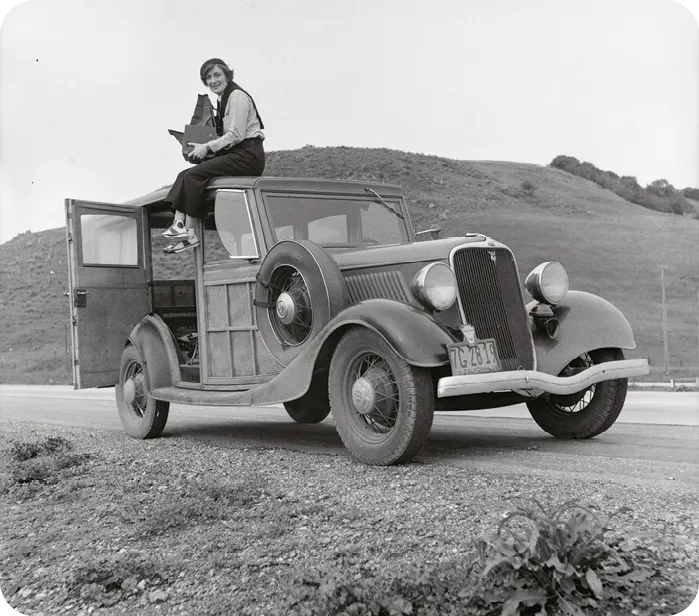
Dorothea Lange sitting on the roof of her Ford Model T, holding her Graflex camera, 1930.
It was during the Depression that I learned how to go everywhere on my own. I bought myself a Model T from a painter I knew who'd moved to Mexico. I learned how to drive. If a project included money for an assistant, I'd sometimes hire Imogen's son, Rondal Partridge, to accompany me, but I liked to know I could get in a car and take myself wherever I needed to go without waiting for anyone. I'd wake up early, before the sunrise, and I'd climb into my car. [...]
Everywhere I went, I heard, “Who is this woman?” “Why is she here?” “What is she doing with a camera?” I learned to answer when I had to and keep quiet when I could. Once I got the hang of it, I found that walking into a new place as a woman had its advantages, as it had with my portrait work. People didn't hide from you as much. I'd wander about with a handheld Graflex and a small notebook, just taking everything in. Usually I didn't bother hiding my limp – it made people kinder to me somehow. If someone seemed uncomfortable or closed off, I'd move away, but otherwise we'd get to talking and they'd tell me their stories. Many times it seemed they'd been waiting for years to tell them.
One afternoon in 1936, I was driving home, when I saw a handwritten sign by the side of the freeway that read PEA PICKERS. I'd been on the road for weeks, and I was eager to get home to my sons. [...]
But then something, some instinct, told me to turn around. At the camp, the earth looked parched despite the recent rains. Heat had splintered the trees in two, and vultures perched on leafless branches. Ahead and all around me there were men, women, children, and infants, a miasma of suffering and endurance. I walked around for a while, and then I saw her: a woman under a faded canvas tent with several children huddled around her.
I waited for her to notice me before approaching. When she finally looked up, a line of confusion appeared on her forehead, but then her face opened.
We see not only with our eyes but with everything we are. Everything that'd happened had brought me to this place and to this time. So many other moments filled that one, so many stories, so many ghosts. I somehow saw them all when I met this woman's gaze.
What seized my attention, what held me there, was the sense of a whole life, a whole story, in the woman's expression.
I walked toward her and said hello. She told me her age – thirty-two – and that she and her seven children had been living off frozen vegetables from the surrounding fields, as well as birds that the children killed. She'd just sold the tires from her car to buy food; she and the children were now marooned in the camp. She seemed to know that my pictures might help her. When I knew she was ready, I tightened my camera strap, checked the lens, then moved closer. I made five exposures, working closer and closer from the same direction.
A photograph is only a piece of paper with a silver image burned onto it, but there's something about some of them – the rare few – that you can't call anything but an act of love. And you give it – not to only one person; you give it to the world.
Everywhere I went, I heard, “Who is this woman?” “Why is she here?” “What is she doing with a camera?” I learned to answer when I had to and keep quiet when I could. Once I got the hang of it, I found that walking into a new place as a woman had its advantages, as it had with my portrait work. People didn't hide from you as much. I'd wander about with a handheld Graflex and a small notebook, just taking everything in. Usually I didn't bother hiding my limp – it made people kinder to me somehow. If someone seemed uncomfortable or closed off, I'd move away, but otherwise we'd get to talking and they'd tell me their stories. Many times it seemed they'd been waiting for years to tell them.
One afternoon in 1936, I was driving home, when I saw a handwritten sign by the side of the freeway that read PEA PICKERS. I'd been on the road for weeks, and I was eager to get home to my sons. [...]
But then something, some instinct, told me to turn around. At the camp, the earth looked parched despite the recent rains. Heat had splintered the trees in two, and vultures perched on leafless branches. Ahead and all around me there were men, women, children, and infants, a miasma of suffering and endurance. I walked around for a while, and then I saw her: a woman under a faded canvas tent with several children huddled around her.
I waited for her to notice me before approaching. When she finally looked up, a line of confusion appeared on her forehead, but then her face opened.
We see not only with our eyes but with everything we are. Everything that'd happened had brought me to this place and to this time. So many other moments filled that one, so many stories, so many ghosts. I somehow saw them all when I met this woman's gaze.
What seized my attention, what held me there, was the sense of a whole life, a whole story, in the woman's expression.
I walked toward her and said hello. She told me her age – thirty-two – and that she and her seven children had been living off frozen vegetables from the surrounding fields, as well as birds that the children killed. She'd just sold the tires from her car to buy food; she and the children were now marooned in the camp. She seemed to know that my pictures might help her. When I knew she was ready, I tightened my camera strap, checked the lens, then moved closer. I made five exposures, working closer and closer from the same direction.
A photograph is only a piece of paper with a silver image burned onto it, but there's something about some of them – the rare few – that you can't call anything but an act of love. And you give it – not to only one person; you give it to the world.
Ressource affichée de l'autre côté.
Faites défiler pour voir la suite.
Faites défiler pour voir la suite.
a) How does the
narrator describe the
relationship between
the photographer and
her subject?
Ressource affichée de l'autre côté.
Faites défiler pour voir la suite.
Faites défiler pour voir la suite.
b) What was the
narrator's new job, and
what did it involve?
Ressource affichée de l'autre côté.
Faites défiler pour voir la suite.
Faites défiler pour voir la suite.
c) What does the
car represent for the
narrator? Why is it
important to her?
Ressource affichée de l'autre côté.
Faites défiler pour voir la suite.
Faites défiler pour voir la suite.
d) How do people react
when they see her
with a camera? Why?
Ressource affichée de l'autre côté.
Faites défiler pour voir la suite.
Faites défiler pour voir la suite.
e) What makes the
narrator stop and turn
around, even though
she wants to go home?
Ressource affichée de l'autre côté.
Faites défiler pour voir la suite.
Faites défiler pour voir la suite.
f) What first
impressions does the
narrator give us of
the pea pickers camp?
Ressource affichée de l'autre côté.
Faites défiler pour voir la suite.
Faites défiler pour voir la suite.
g) What does the
narrator notice about
the woman and her
children? What details
show their difficult
situation?
Ressource affichée de l'autre côté.
Faites défiler pour voir la suite.
Faites défiler pour voir la suite.
h) Why does the
narrator wait before
taking the photo?
Ressource affichée de l'autre côté.
Faites défiler pour voir la suite.
Faites défiler pour voir la suite.
i) What makes an
image powerful or
lasting, in her view?
Ressource affichée de l'autre côté.
Faites défiler pour voir la suite.
Faites défiler pour voir la suite.
Jasmin Darznik is an Iranian-American writer known for her richly researched historical novels. Before The Bohemians, she wrote Song of a Captive Bird, a novel inspired by the life of Iranian poet Forugh Farrokhzad. Darznik blends fiction with biography, using her background as a scholar and storyteller to bring hidden histories to light. Through her writing, she gives voice to women who defied convention and shaped their eras with courage and creativity.


Ressource affichée de l'autre côté.
Faites défiler pour voir la suite.
Faites défiler pour voir la suite.
Through her eyes
Imagine you are the migrant mother who is about to be photographed. Write a first-person narrative that tells the story of that moment from her point of view. What are you feeling as you see the photographer approach? What are you thinking about your children, your past, your future? What do you hope this stranger will do with your image?Une erreur sur la page ? Une idée à proposer ?
Nos manuels sont collaboratifs, n'hésitez pas à nous en faire part.
j'ai une idée !
Oups, une coquille