Vue papier

Découvrez la vue papier en cliquant ici
Unit 9
Activity 1
Imagine the possibilities
Ressource affichée de l'autre côté.
Faites défiler pour voir la suite.
Faites défiler pour voir la suite.
1 Immortality paradox

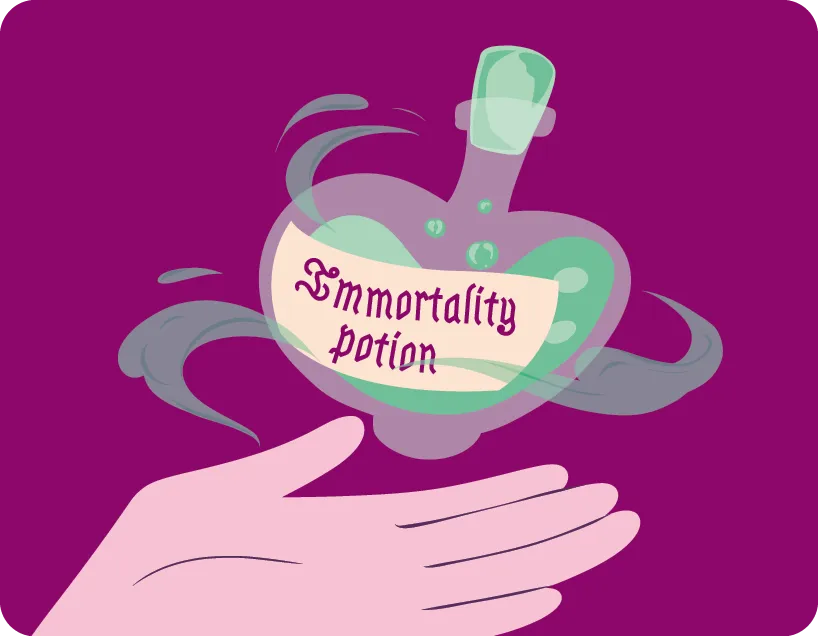
“If you had the chance to be immortal, would you take it?”, TED-Ed, 2025.
Vidéo associée
From 0:00 to 3:04
Ressource affichée de l'autre côté.
Faites défiler pour voir la suite.
Faites défiler pour voir la suite.
2 Eternal dilemma


“If superpowers were real: Immortality”, TED-Ed, 2013.
Vidéo associée
Ressource affichée de l'autre côté.
Faites défiler pour voir la suite.
Faites défiler pour voir la suite.
3The science of Frankenstein
The science
of Frankenstein

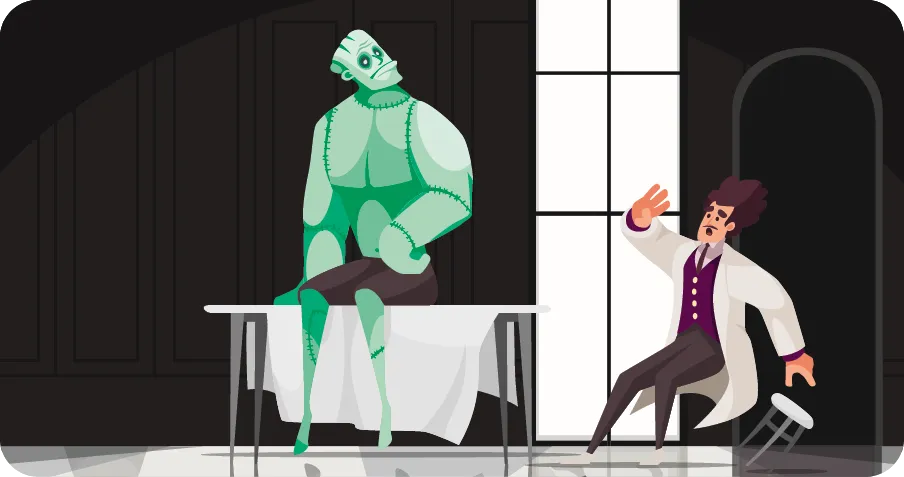
When Mary Shelley wrote Frankenstein in 1818, she imagined immortality as a triumph over death through the reanimation of flesh. Her monster, cobbled together from corpses and sparked to life by electricity, represented humanity's hubris in attempting to transcend mortality through biological manipulation. Shelley's vision was rooted in the scientific lense of her era – galvanism had demonstrated electricity's power to animate dead tissue, and the boundary between life and death seemed within reach.
Shelley's Frankenstein achieved his impossible goal through cellular regeneration and electrical stimulation. The novel emerged during the height of Luigi Galvani's experiments, where electrical currents could make severed frog legs twitch and dance. This seemed to suggest that life itself was merely an electrical phenomenon – that death was simply the cessation of bioelectric activity, reversible through sufficient voltage and scientific knowledge. Shelley extrapolated this concept to its logical extreme: if electricity could animate dead tissue temporarily, perhaps it could restore full consciousness permanently. Her creature represented the ultimate expression of biological immortality.
Shelley's Frankenstein achieved his impossible goal through cellular regeneration and electrical stimulation. The novel emerged during the height of Luigi Galvani's experiments, where electrical currents could make severed frog legs twitch and dance. This seemed to suggest that life itself was merely an electrical phenomenon – that death was simply the cessation of bioelectric activity, reversible through sufficient voltage and scientific knowledge. Shelley extrapolated this concept to its logical extreme: if electricity could animate dead tissue temporarily, perhaps it could restore full consciousness permanently. Her creature represented the ultimate expression of biological immortality.
Ressource affichée de l'autre côté.
Faites défiler pour voir la suite.
Faites défiler pour voir la suite.
Questions
1
Focus on one of the videos. Take notes on the positive and negative aspects of immortality presented.
2
In pairs, share your notes and discuss which example or argument you found most interesting.
3
Read the text. Identify the scientific idea Mary Shelley used to envision immortality. Do you perceive this vision as positive or negative? Go online and read the summary of the novel to complete your answer.
Ressource affichée de l'autre côté.
Faites défiler pour voir la suite.
Faites défiler pour voir la suite.
Background check
How do these stories and ideas show both the promise and the dangers of immortality?
Ressource affichée de l'autre côté.
Faites défiler pour voir la suite.
Faites défiler pour voir la suite.
In pairs, take turns: one of you names a hope or
positive aspect of immortality from the page, and
the other responds with a danger or negative aspect.
Une erreur sur la page ? Une idée à proposer ?
Nos manuels sont collaboratifs, n'hésitez pas à nous en faire part.
j'ai une idée !
Oups, une coquille