Vue papier
Découvrez la vue papier en cliquant ici
Unit 9
Activity 3
Science or fantasy?
Ressource affichée de l'autre côté.
Faites défiler pour voir la suite.
Faites défiler pour voir la suite.
Group 1 Uploading the mind
Group 1
Ressource affichée de l'autre côté.
Faites défiler pour voir la suite.
Faites défiler pour voir la suite.
£

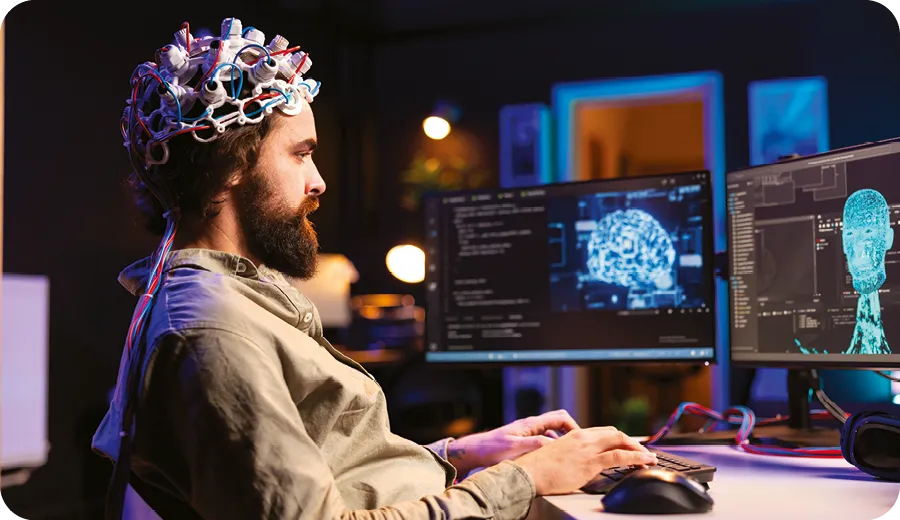
Uploading our minds to a computer, to live on after the inevitable death and decay of our physical bodies, has long been a fantasy of sci-fi films, video games and TV series. [...] Many people might argue that it should stay that way. Like it or not, though, scientists are hard at work as we speak, conducting research that might one day make digitally-assisted eternal life a reality. Some, like computer scientist Ray Kurzweil, believe that humans will be able to upload their entire brains to computers – and thus achieve “digital immortality” – as early as 2045. [...]
But [...] how could it be done? The basic idea rests on several assumptions, says Angela Thornton, a researcher at the Horizon Centre for Doctoral Training at University of Nottingham [...]. “It assumes that we could replicate our brain [with] a certain level of understanding of how it works,” she says. “Not necessarily knowing all the detail, but enough to be able to emulate it.” Then, she adds, we have to make the assumption that the “mind” (i.e. the abstract part of us that thinks, remembers, imagines and senses) naturally emerges from the structures of the physical brain. [...]
Let's say that it is possible to create a full emulation of our brain, and get it up and running on external hardware. How might we interact with the world? As an avatar in a Second Life-style metaverse? As a disembodied brain, floating in space? Or would we move around the real world in a robot shell? There's some debate about whether we'd even be able to cope with our existence without any form of interaction with our environment.
Thornton, whose research involves educating people on the possibilities of mind uploading and documenting their responses, says: “Most people don't want to exist as an avatar in a virtual world. They want to have some kind of form.” This raises another question, though: would we want to limit ourselves to our current understanding of a body, or would we get more creative, expanding on our humanoid form? Could we all be transplanted into Boston Dynamics robot dogs, for example, or a cheetah that's capable of running faster than Usain Bolt?
“There's a lot of freedom that goes with that idea,” says Thornton. “But there's also quite a big adjustment, in terms of your brain and your mind coping with the fact that the shell you're in is completely different.” This could be a terrifying experience, if the mind isn't able to create the illusion that you – the sum of your memories and personality – are still you. “You might just tip over the edge.”
Ressource affichée de l'autre côté.
Faites défiler pour voir la suite.
Faites défiler pour voir la suite.
Questions
You are in charge of one document.
1
What method is being used in your document to try to extend life or “cheat death”? How does it work?
2
What potential benefits are mentioned? What about risks or limitations?
3
Pick one quote or example that shows why people are fascinated by this technology.
Let's talk this out!
4
Present your document, and compare the three approaches. Which seems most realistic, and why?
5
What ethical questions do these technologies raise? Consider both individuals and society.
6
If you had the choice, which method (if any) would you try? Why or why not?
Ressource affichée de l'autre côté.
Faites défiler pour voir la suite.
Faites défiler pour voir la suite.
In small groups, one student starts by naming one of the three life-extension technologies. Taking turns, each group member must say one key word related to that technology.
Ressource affichée de l'autre côté.
Faites défiler pour voir la suite.
Faites défiler pour voir la suite.
Tech talk
As tech experts, you've been invited by the popular science podcast Stuff You Should Know to share your insights on life-extension technology. In groups, discuss the main benefits and risks of the three technologies, and decide which seems most appealing, realistic or ethical. Then, record a short segment summarising your discussion.Une erreur sur la page ? Une idée à proposer ?
Nos manuels sont collaboratifs, n'hésitez pas à nous en faire part.
j'ai une idée !
Oups, une coquille