Vue papier

Découvrez la vue papier en cliquant ici
Unit 12
Activity 2
Romanticizing the wild and our place in it
Ressource affichée de l'autre côté.
Faites défiler pour voir la suite.
Faites défiler pour voir la suite.
ang1-unit12-activity2.mp3
The film [Into the Wild] is based on the nonfiction book “Into the Wild” by Jon Krakauer, based on the true story of Chris McCandless. The film is written and directed by Sean Penn, who spent over ten years attempting to make this movie.
In 1990, after graduating from Emory University, Chris, played by relative newcomer Emile Hirsch, donated his savings to charity and took off on the road, without a word to anyone.
The film follows Chris on his journey, interweaving events from the two years he traveled the country with his last four months, spent in the middle of nowhere in Alaska, which eventually resulted in his death. […]
The soundtrack emphasizes the beauty of the sweeping scenes of mountains, beaches and forests, nature as is, perfect and untouched. It is in this beauty Chris is lost.
The film doesn't end with his family crying or the discovery of his body by a hunting party a few weeks after his death. It ends with Chris. Alone. Penn can rightly be accused of romanticizing Chris's death and the way it came about. The pure emotion evoked from the movie leaves you wrapped in a tangled web of sadness and pity, but removed from the Alaskan mountains and the folksy music, it leaves a bitter taste in your mouth.
We don't see the reactions of Chris's parents or sister, or the girl he left in California, or the hippie couple, the old man, or the farmer. It's as if Chris's death is taken out of context from the rest of the world, perhaps exactly how Chris would have wanted it, but selfish in the fact that none of us, no matter how hard we push, can exist without human relationships or connections.
Because this film is based on a true story, the romanticizing is particularly troubling. It ignores the true pain of Chris's death. At the same time, the film does explore just exactly why Chris felt the need to do what he did. We can almost begin to understand and sympathize with Chris, in his quest to get away from a civilization that, as he sees it, is anything but civil.
In 1990, after graduating from Emory University, Chris, played by relative newcomer Emile Hirsch, donated his savings to charity and took off on the road, without a word to anyone.
The film follows Chris on his journey, interweaving events from the two years he traveled the country with his last four months, spent in the middle of nowhere in Alaska, which eventually resulted in his death. […]
The soundtrack emphasizes the beauty of the sweeping scenes of mountains, beaches and forests, nature as is, perfect and untouched. It is in this beauty Chris is lost.
The film doesn't end with his family crying or the discovery of his body by a hunting party a few weeks after his death. It ends with Chris. Alone. Penn can rightly be accused of romanticizing Chris's death and the way it came about. The pure emotion evoked from the movie leaves you wrapped in a tangled web of sadness and pity, but removed from the Alaskan mountains and the folksy music, it leaves a bitter taste in your mouth.
We don't see the reactions of Chris's parents or sister, or the girl he left in California, or the hippie couple, the old man, or the farmer. It's as if Chris's death is taken out of context from the rest of the world, perhaps exactly how Chris would have wanted it, but selfish in the fact that none of us, no matter how hard we push, can exist without human relationships or connections.
Because this film is based on a true story, the romanticizing is particularly troubling. It ignores the true pain of Chris's death. At the same time, the film does explore just exactly why Chris felt the need to do what he did. We can almost begin to understand and sympathize with Chris, in his quest to get away from a civilization that, as he sees it, is anything but civil.
Ressource affichée de l'autre côté.
Faites défiler pour voir la suite.
Faites défiler pour voir la suite.

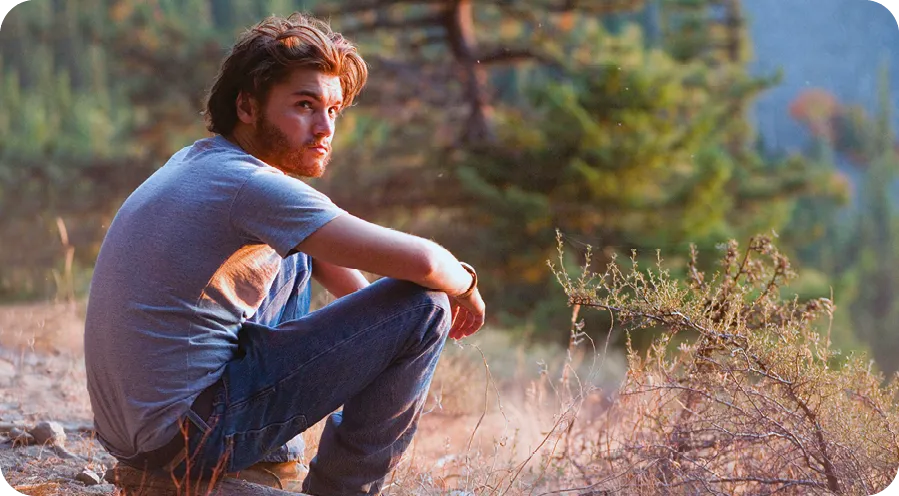
Emile Hirsch as Christopher McCandless in Into the Wild,
directed by Sean Penn, 2007.
Vidéo associée
Ressource affichée de l'autre côté.
Faites défiler pour voir la suite.
Faites défiler pour voir la suite.
PATH A
B1
1-A
Find the sentence that shows how the film ends.
2-A
Note down the words that describe emotions
in the text. What feelings does the film create?
3-A
What does the author think about how the film
presents Chris's death?
Ressource affichée de l'autre côté.
Faites défiler pour voir la suite.
Faites défiler pour voir la suite.
PATH B
B1+
1-B
Identify and explain the author's main
argument about the film. Does she approve
or criticize the way Chris's story is told?
2-B
Explain how the film isolates Chris's death
from the reactions of others.
3-B
Define the word “romanticize”.
Ressource affichée de l'autre côté.
Faites défiler pour voir la suite.
Faites défiler pour voir la suite.
Let's talk this out!
4
Sum up the author's thoughts on the “romanticizing” of Chris's death in the film. Do you agree?
5
Do you understand Chris's wish to escape civilization? Why or why not?
Ressource affichée de l'autre côté.
Faites défiler pour voir la suite.
Faites défiler pour voir la suite.
Stranded on an island!
What three personal belongings would you take with you to a desert island? In groups of three or four, discuss what you would bring. Together, select the three most important ones.
What three personal belongings would you take with you to a desert island? In groups of three or four, discuss what you would bring. Together, select the three most important ones.
Une erreur sur la page ? Une idée à proposer ?
Nos manuels sont collaboratifs, n'hésitez pas à nous en faire part.
j'ai une idée !
Oups, une coquille