Vue papier

Découvrez la vue papier en cliquant ici
Unit 12
Book Club
Walden
Ressource affichée de l'autre côté.
Faites défiler pour voir la suite.
Faites défiler pour voir la suite.
In late March 1845, Henry David Thoreau, a 19th-century American writer
and Transcendentalist philosopher, decided to experiment with simple living
in Walden Pond, Massachusetts (U.S.). During his retreat, he wrote Walden,
or, Life in Woods (published in 1854), a work in which he relates this life of
self-sufficiency.


Ressource affichée de l'autre côté.
Faites défiler pour voir la suite.
Faites défiler pour voir la suite.
Texte
Walden
I went to the woods because I wished to live deliberately, to front only the essential
facts of life, and see if I could not learn what it had to teach, and not, when I came to
die, discover that I had not lived. I did not wish to live what was not life, living is so dear;
nor did I wish to practise resignation, unless it was quite necessary. I wanted to live deep
and suck out all the marrow of life, to live so sturdily and Spartan-like as to put to rout
all that was not life, to cut a broad swath and shave close, to drive life into a corner, and
reduce it to its lowest terms, and, if it proved to be mean, why then to get the whole and
genuine meanness of it, and publish its meanness to the world; or if it were sublime, to
know it by experience, and be able to give a true account of it in my next excursion. […]
Our life is frittered away by detail. An honest man has hardly need to count more than his ten fingers, or in extreme cases he may add his ten toes, and lump the rest. Simplicity, simplicity, simplicity! I say, let your affairs be as two or three, and not a hundred or a thousand; instead of a million count half a dozen, and keep your accounts on your thumb nail. In the midst of this chopping sea of civilized life, such are the clouds and storms and quicksands and thousand-and-one items to be allowed for, that a man has to live, if he would not founder and go to the bottom and not make his port at all, by dead reckoning, and he must be a great calculator indeed who succeeds. Simplify, simplify. Instead of three meals a day, if it be necessary eat but one; instead of a hundred dishes, five; and reduce other things in proportion. […] Men think that it is essential that the Nation have commerce, and export ice, and talk through a telegraph, and ride thirty miles an hour, without a doubt, whether they do or not; but whether we should live like baboons or like men, is a little uncertain. If we do not get out sleepers, and forge rails, and devote days and nights to the work, but go to tinkering upon our lives to improve them, who will build railroads? And if railroads are not built, how shall we get to heaven in season? But if we stay at home and mind our business, who will want railroads? We do not ride on the railroad; it rides upon us. […]
Why should we live with such hurry and waste of life? We are determined to be starved before we are hungry. Men say that a stitch in time saves nine, and so they take a thousand stitches to-day to save nine to-morrow. As for work, we haven't any of any consequence. […]
Our life is frittered away by detail. An honest man has hardly need to count more than his ten fingers, or in extreme cases he may add his ten toes, and lump the rest. Simplicity, simplicity, simplicity! I say, let your affairs be as two or three, and not a hundred or a thousand; instead of a million count half a dozen, and keep your accounts on your thumb nail. In the midst of this chopping sea of civilized life, such are the clouds and storms and quicksands and thousand-and-one items to be allowed for, that a man has to live, if he would not founder and go to the bottom and not make his port at all, by dead reckoning, and he must be a great calculator indeed who succeeds. Simplify, simplify. Instead of three meals a day, if it be necessary eat but one; instead of a hundred dishes, five; and reduce other things in proportion. […] Men think that it is essential that the Nation have commerce, and export ice, and talk through a telegraph, and ride thirty miles an hour, without a doubt, whether they do or not; but whether we should live like baboons or like men, is a little uncertain. If we do not get out sleepers, and forge rails, and devote days and nights to the work, but go to tinkering upon our lives to improve them, who will build railroads? And if railroads are not built, how shall we get to heaven in season? But if we stay at home and mind our business, who will want railroads? We do not ride on the railroad; it rides upon us. […]
Why should we live with such hurry and waste of life? We are determined to be starved before we are hungry. Men say that a stitch in time saves nine, and so they take a thousand stitches to-day to save nine to-morrow. As for work, we haven't any of any consequence. […]

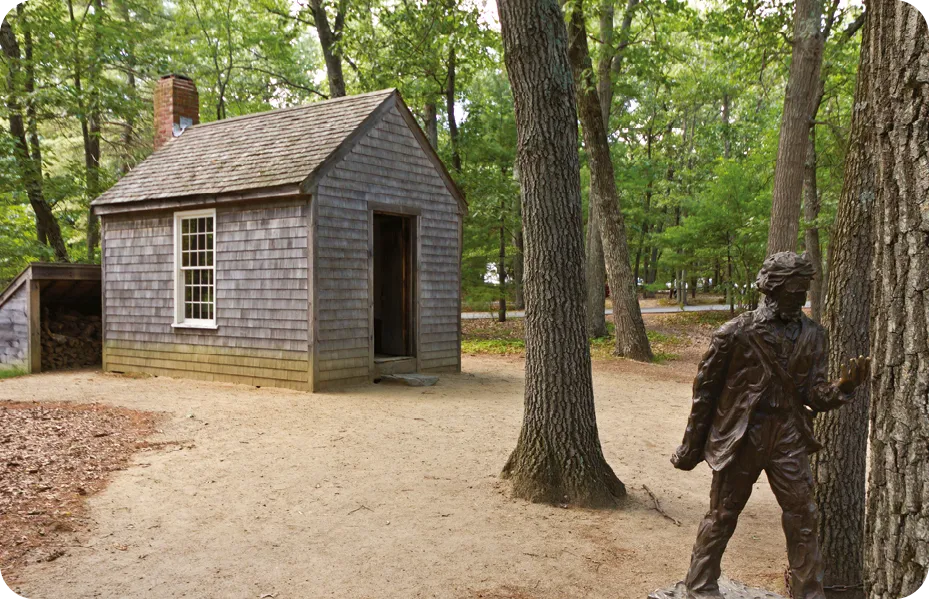
Replica of Thoreau's little one-room cabin in the woods at Walden Pond.
Let us spend one day as deliberately as Nature, and not be thrown off the track by every
nutshell and mosquito's wing that falls on the rails. Let us rise early and fast, or break
fast, gently and without
perturbation;
let company
come and let company
go,
let the bells ring and the
children
cry, – determined
to make a day of it. Why
should we knock under
and go with the stream?
Let us not be upset and
overwhelmed
in that terrible
rapid and whirlpool called
a dinner, situated in the
meridian
shallows. Weather
this danger and you are safe,
for the rest of the way is down hill. With unrelaxed nerves, with morning vigor, sail by it,
looking another way, tied to the mast like Ulysses. If the engine whistles, let it whistle till
it is hoarse for its pains. If the bell rings, why should we run? We will consider what kind
of music they are like. Let us settle ourselves, and work and wedge our feet downward
through the mud and slush of opinion, and prejudice,
and tradition, and delusion, and
appearance, that alluvion which covers the globe.
Ressource affichée de l'autre côté.
Faites défiler pour voir la suite.
Faites défiler pour voir la suite.
a) According to
Thoreau, how do you
“live deep”?
Ressource affichée de l'autre côté.
Faites défiler pour voir la suite.
Faites défiler pour voir la suite.
b) What reason
does he give for
writing this book?
Ressource affichée de l'autre côté.
Faites défiler pour voir la suite.
Faites défiler pour voir la suite.
c) What does he mean
by “simplicity”?
Ressource affichée de l'autre côté.
Faites défiler pour voir la suite.
Faites défiler pour voir la suite.
d) What does he think
of “civilized life”?
Ressource affichée de l'autre côté.
Faites défiler pour voir la suite.
Faites défiler pour voir la suite.
e) What does he
suggest about eating?
Ressource affichée de l'autre côté.
Faites défiler pour voir la suite.
Faites défiler pour voir la suite.
f) What's his take
on railroads and
travelling?
Ressource affichée de l'autre côté.
Faites défiler pour voir la suite.
Faites défiler pour voir la suite.
g) How is this related
to what we call FOMO
(Fear Of Missing Out)
today?
Ressource affichée de l'autre côté.
Faites défiler pour voir la suite.
Faites défiler pour voir la suite.
h) What does he say
about mornings?
Ressource affichée de l'autre côté.
Faites défiler pour voir la suite.
Faites défiler pour voir la suite.
i) What is his advice
about managing
emotions?
Ressource affichée de l'autre côté.
Faites défiler pour voir la suite.
Faites défiler pour voir la suite.
j) How should we react
to distractions?
Ressource affichée de l'autre côté.
Faites défiler pour voir la suite.
Faites défiler pour voir la suite.
k) What do you
understand in the last
sentence?
Ressource affichée de l'autre côté.
Faites défiler pour voir la suite.
Faites défiler pour voir la suite.
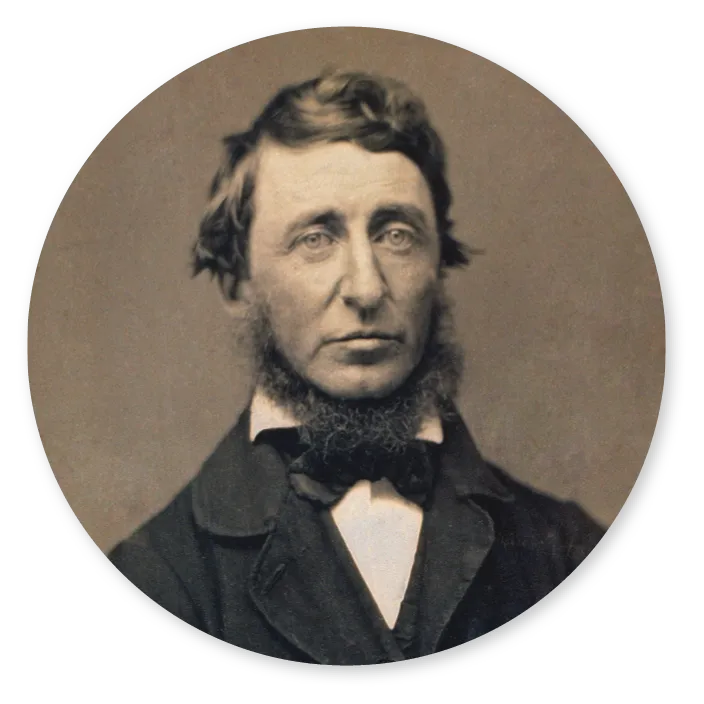
Henry David Thoreau (1817–1862) was an American writer, poet, and
philosopher. He was part of Transcendentalism, a movement that
believed people should live simply, and follow their conscience.
He is best known for Walden, a book about simple living in nature,
and Civil Disobedience, an essay that defends peaceful protest against
injustice. Thoreau was strongly against slavery. He gave speeches to
denounce the laws protecting it and supported people who fought
for freedom, like the abolitionist John Brown. His ideas later inspired
famous leaders such as Tolstoy, Gandhi, and Martin Luther King Jr.

Ressource affichée de l'autre côté.
Faites défiler pour voir la suite.
Faites défiler pour voir la suite.
How to live like Thoreau in five steps!
You have read Walden and found Thoreau's experiment fascinating. You decide to make a tutorial video in which you explain the five steps to take in order to live like Thoreau did.
You have read Walden and found Thoreau's experiment fascinating. You decide to make a tutorial video in which you explain the five steps to take in order to live like Thoreau did.
Une erreur sur la page ? Une idée à proposer ?
Nos manuels sont collaboratifs, n'hésitez pas à nous en faire part.
j'ai une idée !
Oups, une coquille