Vue papier

Découvrez la vue papier en cliquant ici
Case Study 1
Axe 1
Objet d'étude 1
Remembering the Magdalene Laundries
Ressource affichée de l'autre côté.
Faites défiler pour voir la suite.
Faites défiler pour voir la suite.
Write a scene for a screenplay.
You are working on a new film about a painful but important part of Irish history: the Magdalene Laundries. You want to make the past visible through fiction by writing the dialogue for a powerful scene that will move the audience and give a voice to the women who suffered in silence for decades.
You are working on a new film about a painful but important part of Irish history: the Magdalene Laundries. You want to make the past visible through fiction by writing the dialogue for a powerful scene that will move the audience and give a voice to the women who suffered in silence for decades.

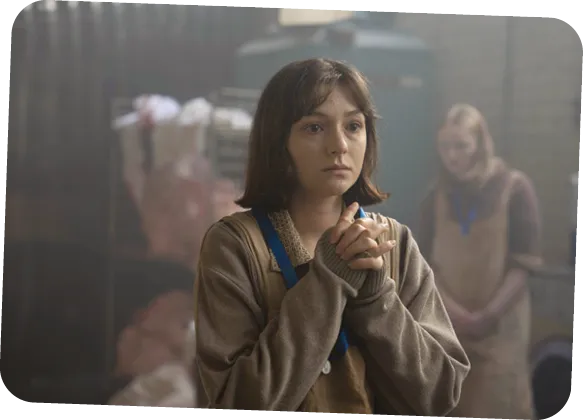
Still from The Woman in the Wall, 2023.
Ressource affichée de l'autre côté.
Faites défiler pour voir la suite.
Faites défiler pour voir la suite.
1
Women in the walls
angt-cs1-step1.mp3
Set in the fictional town of Kilkinure in 20th-century Ireland, the show captures the story of Lorna Brady (Ruth Wilson), an unmarried mother who was formerly detained in a Magdalene Laundry. Established in the 18th century, the laundries catered for so-called “fallen women” who had engaged in sex work or had a child outside of wedlock. Ten of these institutions operated in post-independence Ireland between 1922 and 1996 and at least 10,000 women spent time in them.
Laundries were just one of many mechanisms by which the Catholic Church and the Irish state regulated behaviour that was perceived as deviant. [...] The laundries were part of a broader architecture of containment that included institutions such as industrial schools and psychiatric hospitals. By the 1950s, 1% of Ireland's population was contained in institutions of coercive1 confinement. [...]
The theme of recurrent injustice surfaces throughout the series. Lorna and her contemporaries have not been recognised by the state as detainees of a laundry. Instead, Kilkinure Convent has been classified as a training centre.
The survivors meet with a representative of a lobby group called Éadrom (the Irish word for “light”). This storyline closely mirrors reality. The state's initial response to the laundries was to claim that they were private institutions and the state was not involved. [...]
A formal state apology was offered in February 2013 by taoiseach2 Enda Kenny, who described the laundries as the “nation's shame”. [...]
The Woman in the Wall is not the first cultural representation of a Magdalene Laundry. Films such as The Magdalene Sisters (2002) and Philomena (2013) have also explored this powerful subject matter. But the BBC show's creator and writer Joe Murtagh is the first to use the medium of a “gothic thriller” to explore the laundries' painful nature and legacies – and the effect is unnerving.
1. coercive: forced 2. taoiseach: Prime Minister
Laundries were just one of many mechanisms by which the Catholic Church and the Irish state regulated behaviour that was perceived as deviant. [...] The laundries were part of a broader architecture of containment that included institutions such as industrial schools and psychiatric hospitals. By the 1950s, 1% of Ireland's population was contained in institutions of coercive1 confinement. [...]
The theme of recurrent injustice surfaces throughout the series. Lorna and her contemporaries have not been recognised by the state as detainees of a laundry. Instead, Kilkinure Convent has been classified as a training centre.
The survivors meet with a representative of a lobby group called Éadrom (the Irish word for “light”). This storyline closely mirrors reality. The state's initial response to the laundries was to claim that they were private institutions and the state was not involved. [...]
A formal state apology was offered in February 2013 by taoiseach2 Enda Kenny, who described the laundries as the “nation's shame”. [...]
The Woman in the Wall is not the first cultural representation of a Magdalene Laundry. Films such as The Magdalene Sisters (2002) and Philomena (2013) have also explored this powerful subject matter. But the BBC show's creator and writer Joe Murtagh is the first to use the medium of a “gothic thriller” to explore the laundries' painful nature and legacies – and the effect is unnerving.
1. coercive: forced 2. taoiseach: Prime Minister
Ressource affichée de l'autre côté.
Faites défiler pour voir la suite.
Faites défiler pour voir la suite.


Vidéo associée
Ressource affichée de l'autre côté.
Faites défiler pour voir la suite.
Faites défiler pour voir la suite.
Step 1
1
Watch the video. What does it reveal about the treatment of women in the Magdalene Laundries?
2
Read the text. Pick out facts, dates and numbers, and sum up what you learnt.
3
What is unique about the BBC series The Woman in the Wall compared to earlier films about the laundries?
Action!
Create character ID cards for the main characters in your scene. Include their names, ages and roles.
Ressource affichée de l'autre côté.
Faites défiler pour voir la suite.
Faites défiler pour voir la suite.
2
Small things, big impact
angt-cs1-step2.mp3
Bill Furlong, a coal merchant in 1980s Ireland, crosses paths with Sarah, a young woman from a Magdalene Laundry, who asks him for help. One day, he decides to act.
“You'll come home with me now, Sarah.”
Easily enough he helped her along the front drive and down the hill, past the fancy houses and on towards the bridge. [...]
As they walked on, Furlong met people he had known and dealt with for the greater part of his life, most of whom gladly stopped to speak until, looking down, they saw the bare, black feet and realised the girl with him was not one of his own. Some then gave them a wide berth1 or talked awkwardly or politely wished him a Happy Christmas and went on. One elderly woman out walking a terrier on a long strap confronted him, asking who the girl was, and was she not one of those wans from the laundry? [...] Not one person they met addressed Sarah or asked where he was taking her. Feeling little or no obligation to say very much or to explain, Furlong smoothed things over as best he could and carried on along with the excitement in his heart matched by the fear of what he could not yet see but knew he would encounter.
As they were nearing the centre of town and the Christmas lights, a part of him considered backing off and taking the long way home but he braved it out and carried on, following the path he ordinarily would have taken. [...]
“We've not far to go now,” Furlong assured. “We're almost home.”
As they carried on along and met more people Furlong did and did not know, he found himself asking was there any point in being alive without helping one another? [...]
How light and tall he almost felt walking along with this girl at his side and some fresh, new, unrecognisable joy in his heart. Was it possible that the best bit of him was shining forth, and surfacing? [...]
The worst was yet to come, he knew. Already he could feel a world of trouble waiting for him behind the next door, but the worst that could have happened was also already behind him; the thing not done, which could have been – which he would have had to live with for the rest of his life.
1. “gave them a wide berth”: avoided them on purpose
“You'll come home with me now, Sarah.”
Easily enough he helped her along the front drive and down the hill, past the fancy houses and on towards the bridge. [...]
As they walked on, Furlong met people he had known and dealt with for the greater part of his life, most of whom gladly stopped to speak until, looking down, they saw the bare, black feet and realised the girl with him was not one of his own. Some then gave them a wide berth1 or talked awkwardly or politely wished him a Happy Christmas and went on. One elderly woman out walking a terrier on a long strap confronted him, asking who the girl was, and was she not one of those wans from the laundry? [...] Not one person they met addressed Sarah or asked where he was taking her. Feeling little or no obligation to say very much or to explain, Furlong smoothed things over as best he could and carried on along with the excitement in his heart matched by the fear of what he could not yet see but knew he would encounter.
As they were nearing the centre of town and the Christmas lights, a part of him considered backing off and taking the long way home but he braved it out and carried on, following the path he ordinarily would have taken. [...]
“We've not far to go now,” Furlong assured. “We're almost home.”
As they carried on along and met more people Furlong did and did not know, he found himself asking was there any point in being alive without helping one another? [...]
How light and tall he almost felt walking along with this girl at his side and some fresh, new, unrecognisable joy in his heart. Was it possible that the best bit of him was shining forth, and surfacing? [...]
The worst was yet to come, he knew. Already he could feel a world of trouble waiting for him behind the next door, but the worst that could have happened was also already behind him; the thing not done, which could have been – which he would have had to live with for the rest of his life.
1. “gave them a wide berth”: avoided them on purpose


Ressource affichée de l'autre côté.
Faites défiler pour voir la suite.
Faites défiler pour voir la suite.
Step 2
1
Read the text. Who are the two characters walking through the town? What do you understand about the situation?
2
What reactions do they get from the people they meet? How does Furlong respond to them?
3
Listen to the audio. According to Cillian Murphy, what motivates Furlong's actions?
4
What impact does storytelling have on the reader and the viewer?
Action!
Outline your scene. Decide where it takes place and what happens. Is it a confrontation, a turning point or a quiet moment?
Ressource affichée de l'autre côté.
Faites défiler pour voir la suite.
Faites défiler pour voir la suite.
Ready...
- Gather your notes from the documents. Make sure you understand the context, and that your characters are realistic.
Steady...
- Decide what happens in your scene and how your characters will interact. Think about a key moment of tension, decision or emotion.
Go!
- Write the dialogue for your scene. Show your characters' feelings and thoughts, and include details that will make the scene vivid.
Une erreur sur la page ? Une idée à proposer ?
Nos manuels sont collaboratifs, n'hésitez pas à nous en faire part.
j'ai une idée !
Oups, une coquille