Unit 6
Activity 2
“Who controls the present controls the past.”
Ressource affichée de l'autre côté.
Faites défiler pour voir la suite.
Faites défiler pour voir la suite.
angt-unit6-activity2.mp3
When people use the term “Orwellian,” it's not a good sign.
It usually characterizes an action, an individual or a society that is suppressing freedom, particularly the freedom of expression. It can also describe something perverted by tyrannical power.
It's a term used primarily to describe the present, but whose implications inevitably connect to both the future and the past. [...]
Author George Orwell believed in objective, historical truth. Writing in 1946, he attributed his youthful desire to become an author in part to a “historical impulse,” or “the desire to see things as they are, to find out true facts and store them up for the use of posterity.”
But while Orwell believed in the existence of an objective truth about history, he did not necessarily believe that truth would prevail.
During World War II, the Nazis broadcast reports on German radio describing nonexistent air raids over Britain.
Orwell knew about those reports and wrote: “Now, we are aware that those raids did not happen. But what use would our knowledge be if the Germans conquered Britain? For the purposes of a future historian, did those raids happen, or didn't they?”
The answer, Orwell wrote, was, “If Hitler survives, they happened, and if he falls, they didn't happen. So with innumerable other events of the past ten or twenty years. [...] In no case do you get one answer which is universally accepted because it is true: in each case you get a number of totally incompatible answers, one of which is finally adopted as the result of a physical struggle. History is written by the winners.”
As Orwell wrote in 1984, his final, dystopian novel, “Who controls the past controls the future. Who controls the present controls the past.”
Power, Orwell appreciated, allowed those who possessed it to create their own historical narrative. It also allowed those in power to silence or censor opposing narratives, quashing the possibility of productive dialogue about history that could ultimately allow truth to come out.
It usually characterizes an action, an individual or a society that is suppressing freedom, particularly the freedom of expression. It can also describe something perverted by tyrannical power.
It's a term used primarily to describe the present, but whose implications inevitably connect to both the future and the past. [...]
Author George Orwell believed in objective, historical truth. Writing in 1946, he attributed his youthful desire to become an author in part to a “historical impulse,” or “the desire to see things as they are, to find out true facts and store them up for the use of posterity.”
But while Orwell believed in the existence of an objective truth about history, he did not necessarily believe that truth would prevail.
During World War II, the Nazis broadcast reports on German radio describing nonexistent air raids over Britain.
Orwell knew about those reports and wrote: “Now, we are aware that those raids did not happen. But what use would our knowledge be if the Germans conquered Britain? For the purposes of a future historian, did those raids happen, or didn't they?”
The answer, Orwell wrote, was, “If Hitler survives, they happened, and if he falls, they didn't happen. So with innumerable other events of the past ten or twenty years. [...] In no case do you get one answer which is universally accepted because it is true: in each case you get a number of totally incompatible answers, one of which is finally adopted as the result of a physical struggle. History is written by the winners.”
As Orwell wrote in 1984, his final, dystopian novel, “Who controls the past controls the future. Who controls the present controls the past.”
Power, Orwell appreciated, allowed those who possessed it to create their own historical narrative. It also allowed those in power to silence or censor opposing narratives, quashing the possibility of productive dialogue about history that could ultimately allow truth to come out.
Ressource affichée de l'autre côté.
Faites défiler pour voir la suite.
Faites défiler pour voir la suite.

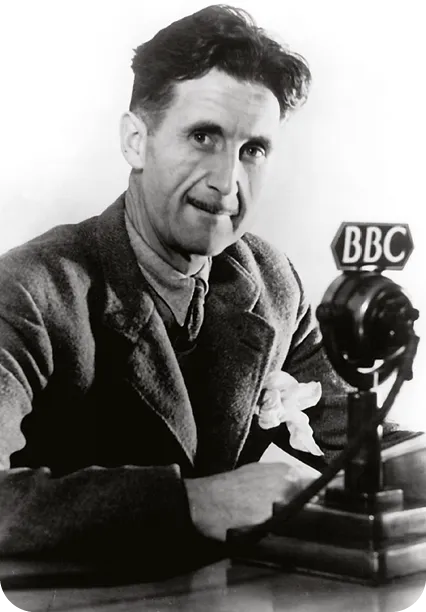
George Orwell.
Ressource affichée de l'autre côté.
Faites défiler pour voir la suite.
Faites défiler pour voir la suite.
PATH A
B1
1-A
When do people use the term “Orwellian”?
Give an example.
2-A
What point was Orwell making about the radio
reports broadcast by the Nazis during World War II?
3-A
What does this show about power and
information?
Ressource affichée de l'autre côté.
Faites défiler pour voir la suite.
Faites défiler pour voir la suite.
PATH B
B2
1-B
Sum up Orwell's belief about historical truth.
2-B
What did Orwell mean when he wrote:
“Who controls the past controls the future.
Who controls the present controls the past.”?
3-B
Explain the quote “History is written by
the winners.”
Ressource affichée de l'autre côté.
Faites défiler pour voir la suite.
Faites défiler pour voir la suite.
Let's talk this out!
4
Share your findings, then explain the relationship between “truth” and “power.”
5
To what extent do you think that Orwell was right? Can you find an example in today's world?
Ressource affichée de l'autre côté.
Faites défiler pour voir la suite.
Faites défiler pour voir la suite.
Dystopia in the headlines
As a journalist for your school's newspaper, you have decided to address the way dystopian fiction reflects real-world events, such as restrictions on freedom, media influence, or current crises. Use examples from books, films, or TV series, and explain what these stories can teach us about the world today.
As a journalist for your school's newspaper, you have decided to address the way dystopian fiction reflects real-world events, such as restrictions on freedom, media influence, or current crises. Use examples from books, films, or TV series, and explain what these stories can teach us about the world today.
Une erreur sur la page ? Une idée à proposer ?
Nos manuels sont collaboratifs, n'hésitez pas à nous en faire part.
j'ai une idée !
Oups, une coquille