Vue papier
Découvrez la vue papier en cliquant ici
Unit 14
Activity 2
Shaping opinions worldwide
Ressource affichée de l'autre côté.
Faites défiler pour voir la suite.
Faites défiler pour voir la suite.
angt-unit14-activity2.mp3

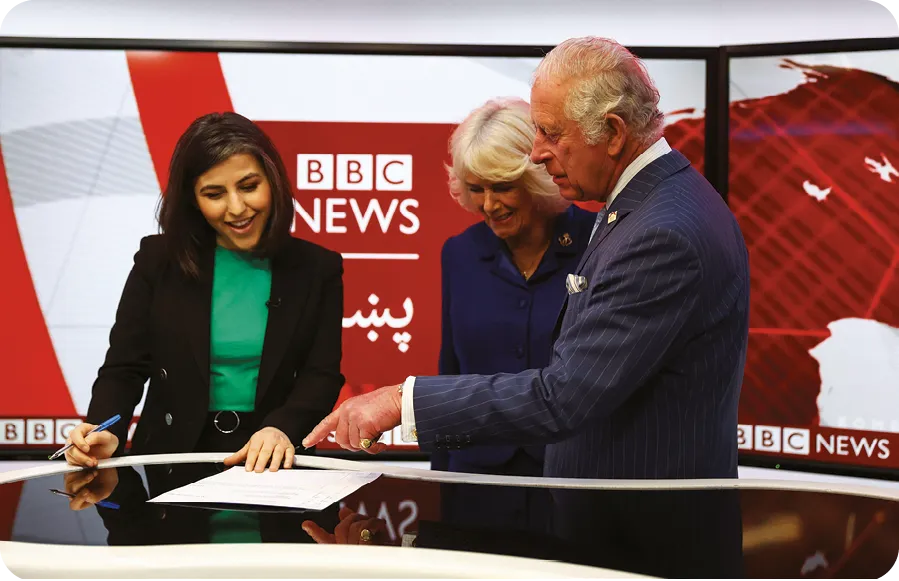
Jonathan Munro, the global director of the BBC, said: “When it comes to international impact and influence, the BBC World Service is the UK's most powerful asset”.
“While we currently deliver news in 42 languages to over 400m people every week, at the greatest value for money compared to other international news providers, we are ambitious about going further to provide independent news where there is a vital need.”
The service is just one institution promoting Britain's soft power abroad, but it is arguably the most powerful, reaching 450m people a week, according to the broadcaster's own figures.
When pollsters asked people from around the world about various British exports and organisations, the BBC came out well ahead of any other, with nearly 80% having heard of it and nearly 50% saying it made them feel more positively about the UK. In comparison, only about 55% had heard of the monarchy, and only 25% said it made them view the UK more favourably. [...]
Jonathan McClory, the managing partner at Sanctuary Counsel and an expert on soft power, said: “It's a gratuitous accident of history that we have the BBC World Service. You couldn't recreate it if you were starting from scratch, but it enables us to shape a global information landscape and promote British values, such as a free press, transparency and broad support for human rights.” [...]
But supporters of the organisation fear that budgetary pressure has left its influence on the wane. [...]
Most of the service's £400m budget still comes from licence fee money – a situation the director general, Tim Davie, has warned is not sustainable, especially when domestic operations are being cut.
While it will not shut down operations in entire countries, BBC insiders say they are likely to have to close certain foreign language services where there are relatively few people who speak that language.
“While we currently deliver news in 42 languages to over 400m people every week, at the greatest value for money compared to other international news providers, we are ambitious about going further to provide independent news where there is a vital need.”
The service is just one institution promoting Britain's soft power abroad, but it is arguably the most powerful, reaching 450m people a week, according to the broadcaster's own figures.
When pollsters asked people from around the world about various British exports and organisations, the BBC came out well ahead of any other, with nearly 80% having heard of it and nearly 50% saying it made them feel more positively about the UK. In comparison, only about 55% had heard of the monarchy, and only 25% said it made them view the UK more favourably. [...]
Jonathan McClory, the managing partner at Sanctuary Counsel and an expert on soft power, said: “It's a gratuitous accident of history that we have the BBC World Service. You couldn't recreate it if you were starting from scratch, but it enables us to shape a global information landscape and promote British values, such as a free press, transparency and broad support for human rights.” [...]
But supporters of the organisation fear that budgetary pressure has left its influence on the wane. [...]
Most of the service's £400m budget still comes from licence fee money – a situation the director general, Tim Davie, has warned is not sustainable, especially when domestic operations are being cut.
While it will not shut down operations in entire countries, BBC insiders say they are likely to have to close certain foreign language services where there are relatively few people who speak that language.
Ressource affichée de l'autre côté.
Faites défiler pour voir la suite.
Faites défiler pour voir la suite.
PATH A
B1
1-A
Find a quote in the text that shows
the BBC reaches audiences outside the UK.
2-A
List the main British values exported through
the BBC.
3-A
Where may the BBC World Service stop
broadcasting in the future? Why?
Ressource affichée de l'autre côté.
Faites défiler pour voir la suite.
Faites défiler pour voir la suite.
PATH B
B2
1-B
How does the BBC act as a tool of British
soft power? Give examples from the text.
2-B
Explain how the BBC World Service helps people
around the world view the UK more positively.
3-B
How could budgetary pressures impact
the BBC's influence abroad?
Ressource affichée de l'autre côté.
Faites défiler pour voir la suite.
Faites défiler pour voir la suite.
Let's talk this out!
4
Share your findings. Sum up what you have learnt about the international influence of the BBC through its World Service, and the challenges its World Service faces.
5
Do you think the BBC should continue to invest in its World Service? Why?
Ressource affichée de l'autre côté.
Faites défiler pour voir la suite.
Faites défiler pour voir la suite.
Pitch a soft power programme.
The BBC World Service is planning its next international strategy to promote British culture abroad. As a BBC content planner, pitch a new international programme (format, theme, target audience), and explain how your idea could shape positive opinions about Britain.
The BBC World Service is planning its next international strategy to promote British culture abroad. As a BBC content planner, pitch a new international programme (format, theme, target audience), and explain how your idea could shape positive opinions about Britain.
Une erreur sur la page ? Une idée à proposer ?
Nos manuels sont collaboratifs, n'hésitez pas à nous en faire part.
j'ai une idée !
Oups, une coquille